Customer Experience
How Visual Proof Turns a "No" Into Approved Repairs
Customer Experience
Every service advisor knows this phone call. A technician found worn brake pads, a leaking valve cover gasket, and a tire with cord showing. You call the customer, walk through the list, quote the price, and hear the same four words: "I'll think about it."
Chances are, they won't. "I'll think about it" is a polite no, and it has very little to do with the repair itself. The customer is not weighing your estimate — they are deciding whether to believe you. That is the real job at the counter, which boils down to trust. The easiest way to drive more business is to stop describing problems to customers and show them what’s wrong.
Picture a customer who had one bad experience at a shop years ago. They were told they needed something, paid for it, and never knew if it was real. Now, you are telling them they need a $700 brake job on a car that stops fine. Nothing you say over the phone can prove you are different from the last shop.
Distrust of automotive repair is a common problem. Roughly two in three U.S. drivers say they do not trust auto repair shops in general, according to a consumer survey from AAA, the motor club and roadside assistance organization. When AAA asked why, the top answer was not price. It was the fear of being sold work they did not need.
The breakdown from that survey:
There is a second reason customers decline, and it is just as fixable. The Auto Care Association, the trade group for the aftermarket, pegged knowingly delayed maintenance at about $25 billion a year, drawing on a survey of more than 100,000 households. Consumers gave three main reasons for putting work off: money, convenience, and a belief that the delay was not really hurting the car.
Your customer suspects the recommendation might be padded, and they think the problem is not that bad anyway. A phone call cannot fully address either doubt. A photo of a brake pad worn to the backing plate answers both questions in the customer’s mind.
Start with the math. Say a service advisor recommends $1,500 of additional work across a handful of cars on a Tuesday. If about one in six customers says yes, the shop sells roughly $250 of it. If about four in 10 say yes, the shop sells roughly $600 of the same work. The only thing that changed was whether the customer saw the problem.
Those two approval rates are not made up. They come from the 2025 U.S. Aftermarket Service Index from J.D. Power, the consumer research firm best known for its satisfaction rankings. Among full-service maintenance and repair customers who received a multi-point inspection with photo or video, 41% had the recommended work done. Among customers who received the inspection without photo or video, only 17% did. The study surveyed 10,348 vehicle owners.
The year before told the same story. In J.D. Power's 2024 Aftermarket Service Index, 51% of customers who got a photo or video with their inspection approved the recommended work, compared with 24% who got the inspection alone. That’s roughly half versus roughly one in four. That study also found that 23% of customers did not receive a photo or video at all, which means most shops are leaving money on the table.
The pattern across the research is consistent enough to ask why it holds. Part of it is how people process information. Psychologists have shown since the 1970s that people recall pictures far better than words, a finding known as the picture superiority effect and tied to work by researcher Allan Paivio. A customer who hears "your pads are at two millimeters" has to hold a number in their head and decide what it means. A customer who sees a photo of a thin pad next to a new one does not have to decide anything. Digital vehicle inspection images tell the whole story.
The bigger part is what the picture does to the trust question. Remember the top fear from the AAA survey: being sold work they do not need. A verbal recommendation asks the customer to take your word for it. A digital vehicle inspection photo of the part on their car moves the conversation from an issue of trust to actually seeing a problem firsthand. Most customers that are shown a tire with steel cord poking through do not need to trust anyone. They can see it.
Visual proof also handles the second objection, the one from the Auto Care data about customers believing repair delays are harmless. A photo of coolant crusted around a water pump weep hole makes the danger of waiting concrete. The customer is no longer picturing a vague future failure. They are looking at the start of one.
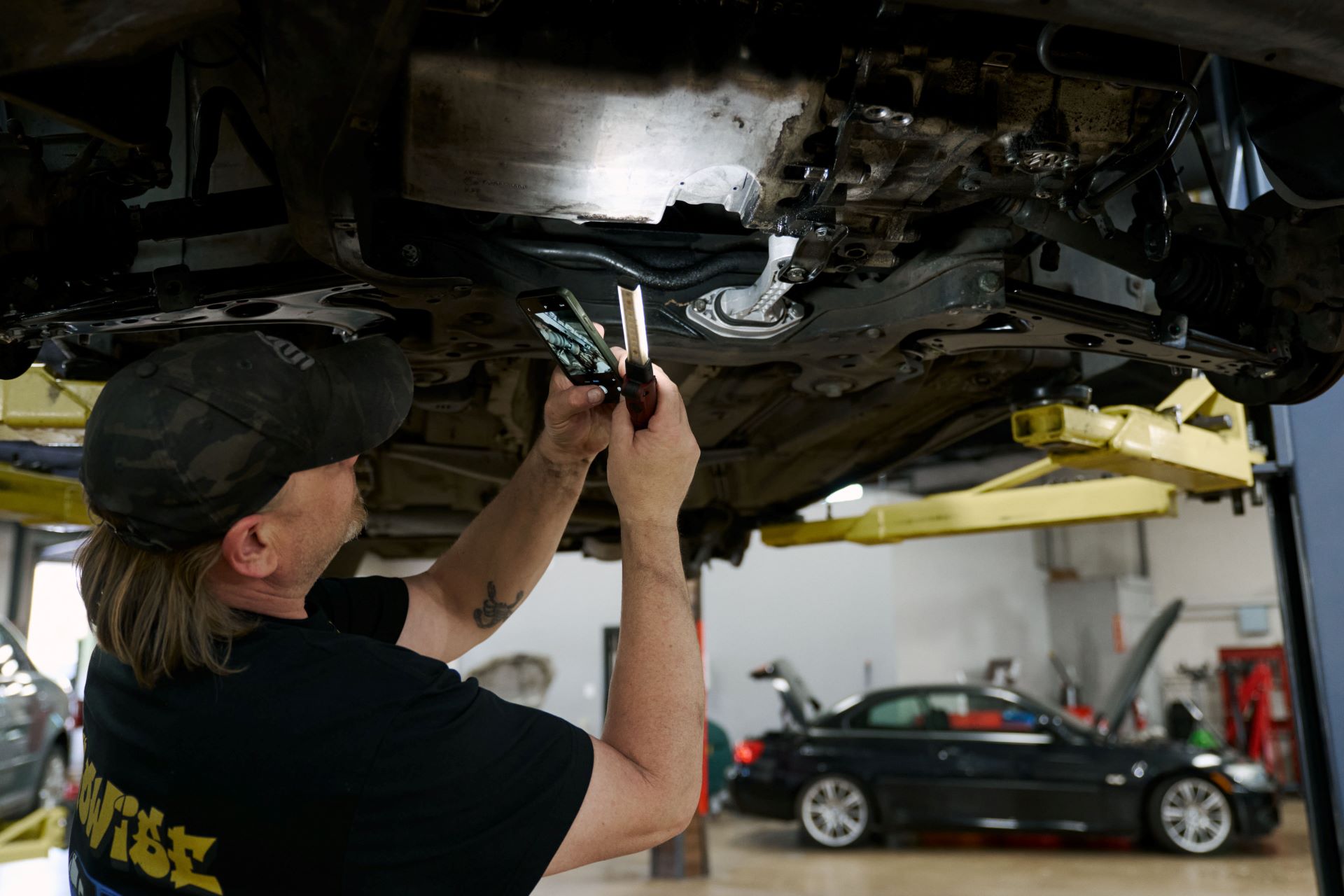
Shooting photos for digital vehicle inspections is not the hard part. Most technicians already carry a phone. The hard part is doing it in a way that actually moves a decision. Shops that get consistent results tend to do a few things the same way.
Shoot the problem next to the standard. A photo of a worn pad means nothing to someone who has never seen a new one. A worn pad beside a new pad, or a tread gauge sitting in the groove, gives the customer the comparison they need to judge for themselves. The goal is a picture that needs no explanation.
One finding, one photo, one sentence. Thirty pictures of the undercarriage tells the customer you are thorough and tells them nothing else. Pair each recommendation with the single image that proves it and a plain-language line about what happens if it waits.
Send it before you call. Customer satisfaction gains are largest when photos and videos arrive early in the visit. A customer who has already looked at the photos and videos is having a different conversation when the phone rings than one with no information. You are no longer convincing them and instead are answering their questions.
Lead with safety, then the rest. Sort the findings so the first digital vehicle inspection photo the customer sees is the one that matters most. Tires, brakes, and steering components go first. Cabin filters go last. Customers who approve the safety item often approve the next one, too.
Show the good news, too. A photo of a healthy belt or a clean air filter, marked as fine, does two things. It proves the inspection was real, and it proves you are not padding the list. That second point is the direct answer to the top fear in the AAA data, and it costs you nothing.
Let the customer keep the proof. A photo the customer can pull up on their own phone six months later does more for your shop than the sale it closed today. It is the receipt for your honesty. When the next shop tells them they need something, they will remember who showed them the part.
Do photos really increase repair approval rates?
Yes, across every major consumer study that has measured it. The clearest aftermarket figure comes from J.D. Power's 2025 U.S. Aftermarket Service Index, where 41% of full-service repair customers approved recommended work when it came with photo or video, compared with 17% without. The exact lift varies by study and customer type, but the direction has held for a decade.
Is video better than photos?
The research groups photo and video together, so there is no clean public data separating them. In practice, a short video works best for things a photo cannot capture, like play in a tie rod or a noise from a wheel bearing. A photo is faster to shoot, faster to review, and enough for most wear items.
How many photos should go with an inspection?
Enough to prove each recommendation, and no more. One clear image per finding, with a one-line note about what it means. Add a few "this is fine" photos to show the inspection was real. If a customer has to scroll past 25 images to find the one that matters, most will not.
When should the customer see the photos?
Before the phone call, not during it. Send the inspection results, give the customer a few minutes to look, then call. The conversation shifts from explaining the problem to answering questions about the fix.
What if the customer still says no?
Some will. A photo removes the trust objection, not the budget objection. When a customer declines a documented safety item, note it on the repair order, keep the photo attached, and let them know you will check it again next visit. The documentation protects the shop, and the customer now knows exactly what they are driving on.
FILED UNDER
Customer Experience
THE PEOPLE BEHIND THE STORY