Published by

Customer Experience
Most customers who put off a repair plan to do it eventually. Here is how to make sure they do it at your shop, with a follow-up routine your team can run every day.
Play audio
Table of contents
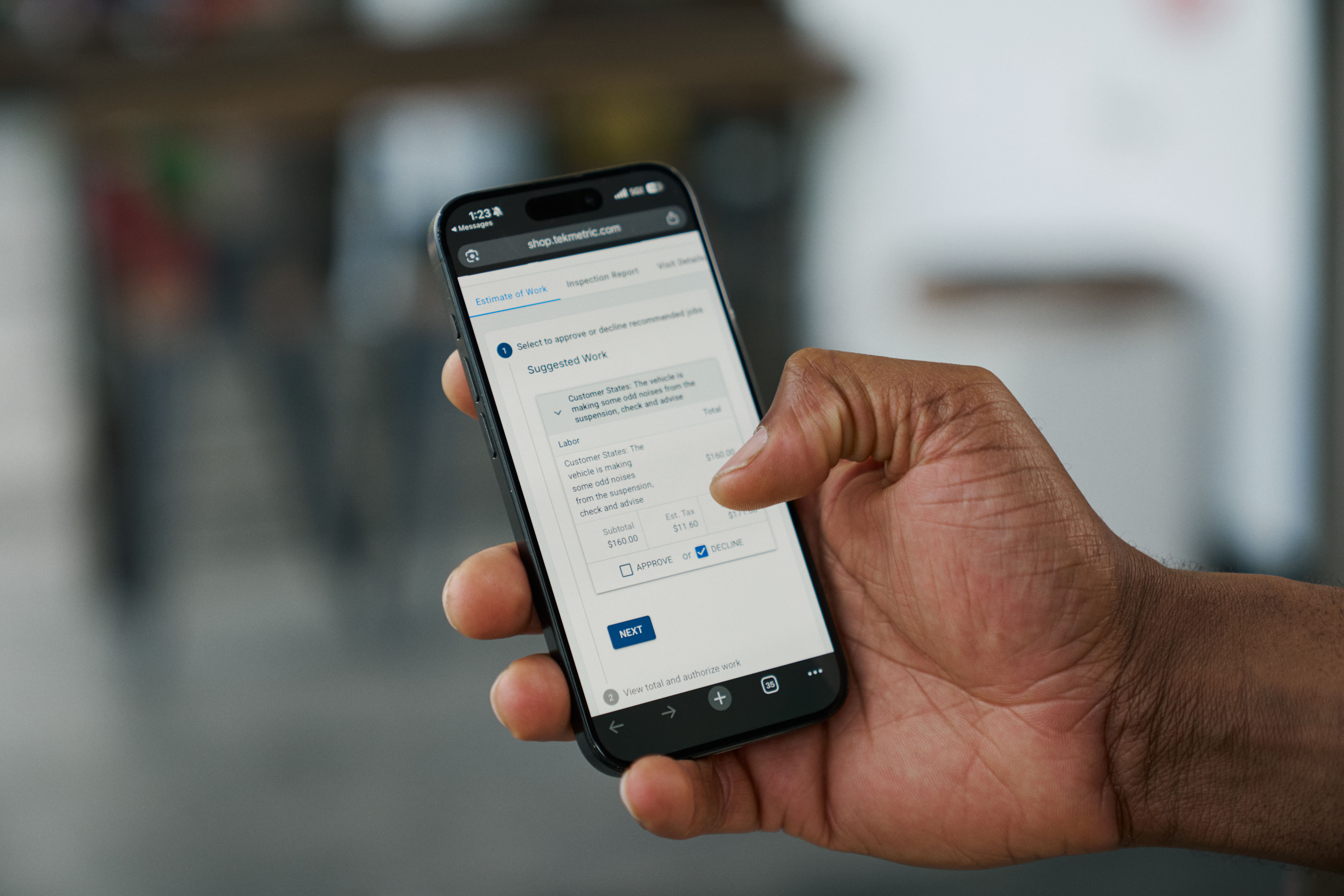
A customer looks at the estimate and says, "not today." Your service advisor says, "No problem, we'll note it on the repair order." The car leaves with worn rear pads and a note nobody is assigned to read. Six weeks later the customer hears the grinding, pulls into the shop closest to work, and buys the brake job there. Your technician found it, your advisor quoted it, but someone else got paid for it.
That is the follow-up gap.
Your technician found the work, but nobody from your shop touched base with the customer since their service. In most shops, that gap stays open for one reason: nobody owns it. The advisor is on the next phone call, the owner is chasing parts, and the deferred work sits in the file until the customer comes back or goes somewhere else.
Closing that gap is a habit most shops need to implement. This piece covers what the gap costs you, why customers put work off, and how to build a follow-up routine your team can run every day without a meeting about it.
The follow-up gap is the time between a customer declining or deferring recommended work and the shop's next contact with that customer about it. Every repair order with an unsold recommendation opens a gap. The gap closes when the shop reaches out and the customer books the work.
Shops that close the gap do three things on a schedule: a check-in after every visit, a follow-up on every piece of deferred work, and a reminder when maintenance comes due.
Picture a shop that sees 300 cars a month. On about 100 of those visits, the service advisor recommends work the customer puts off. Call it $500 of deferred work per car. That is $50,000 a month in work your technicians already found, wrote up, and quoted, walking out the door.
Now picture the same shop with a follow-up habit that brings back one in five of those customers. That is $10,000 a month back into the bays. Over a year, that is $120,000 of work you did not have to advertise for, inspect for, or estimate twice.
Run the math on your own numbers: your monthly car count, times the share of repair orders with deferred work, times your average deferred dollars. That is the size of your follow-up gap.
Nationally, the pile is big. Research firm IMR Inc., working with the Auto Care Association's Factbook, put knowingly delayed vehicle maintenance at $25 billion a year, based on a survey of 100,000 households. The direction is what matters. A large share of the work your shop recommends does not get sold when it is recommended.
Most customers who defer work are not saying no. They are saying not now.
IMR's tracking study on delayed maintenance found that 91% of consumers who put off routine maintenance still expected to get it done. Some 43% plan to do it within a month, and about three in four people plan to do deferred work within three months.
Read that again from your counter. Most of the customers who told your advisor "not today" intend to buy that repair within 90 days, and they intend to pay a shop to do it. The only open question is which shop.
The same IMR research found the two biggest reasons for delay are not what most advisors assume:
Convenience edges out cost. A customer who could not find a convenient time does not need a discount. They need someone to call on a Tuesday and offer a Thursday slot.
Shops lose customers over silence more often than they lose them over price.
AAA's survey of 1,001 U.S. drivers found that about 64% had a repair shop they trusted, which means roughly one in three did not. Younger drivers were far less likely to have a preferred shop. About half of millennials (55%) and Gen X drivers (56%) had one, compared with about three in four baby boomers (76%). Every younger customer who leaves your shop without a trusted-shop relationship is a customer who could pick a different shop next time.
Follow-up is how you become a trusted shop. J.D. Power's 2026 U.S. Aftermarket Service Index, based on 10,572 vehicle owners surveyed from January through March 2026, found aftermarket providers fix problems right the first time more than 95% of the time. Customers still rated their trust in those shops lower than their trust in dealerships, especially on complex repairs. J.D. Power named inconsistent post-service follow-up as one of the clearest opportunities for aftermarket shops to close that trust gap.
Good follow-up habits have a trigger, an action, and an owner. Follow-up in a strong shop has all three.
Trigger: any repair order closed in the last two days.
Action: one short text or call. "Hi, this is Dana from the shop. I’m checking that the brakes feel right. If anything is off, call me directly." No survey link. No review request yet. The point is to make sure the car is fixed and the customer knows you care that it is.
Why it works: a returned vehicle you catch on day two is a quick fix and a story the customer tells in your favor. The same problem found by another shop on day 20 is a lost customer.
Trigger: a repair order with declined or deferred recommendations.
Action: three touches, spaced a month apart, each one shorter than the last.
The spacing of those follow-ups is important, especially given the IMR findings. Roughly four in 10 deferred customers plan to act within a month. About three in four plan to act within three months. Your three touches land exactly where the customer's intent is.
When reaching out, lead with the specific finding and measurement from the inspection, not a generic "you have services due." Specific beats generic because it proves your technician actually looked. And be sure to offer a time slot.
Trigger: mileage or time interval reached, based on the last repair order.
Action: one text or email naming the service and the vehicle. "Your 2019 F-150 is coming up on 90,000 miles. That's transmission fluid and a coolant check. Want us to pencil you in?"
Why it matters: the average vehicle on U.S. roads was 12.8 years old in 2025, according to S&P Global Mobility. Older cars need more scheduled work, and the owner rarely tracks it. The shop that tracks it for them becomes the default.
This is where most shops fail. Everyone agrees that follow-ups matter, but nobody is on the hook for it.
Pick one person. In a shop with one or two service advisors, that is usually the advisor who wrote the repair order because they know the customer and the car. In a larger shop, it can be a dedicated role or a rotating duty. No matter the shop structure, it’s important to follow the rule that every open follow-up has a name next to it.
Give shop employees a designated block of time to follow-up. Twenty minutes, at the same time every day, before the phones get loud. Most shops find that 8:30 a.m. or the half hour after lunch works. During that block, work the follow-up list: today's 48-hour check-ins, today's 30-, 60-, and 90-day touches, and today's maintenance reminders. Nothing else.
Be sure to make the follow-up list visible. Whether it lives in your shop management software, a spreadsheet, or a clipboard by the counter, the follow-up queue should be something shop employees can quickly glance at and see is empty by 9 a.m. If the list is not visible, it is not a habit. It is a hope.
Finally, log every touch on the repair order. Who reached out, when, by which channel, and what the customer said. The next person who picks up the phone should never have to ask the customer to repeat themselves.
Text, unless the customer tells you otherwise.
J.D. Power's 2026 Aftermarket Service Index found that more than half of customers across all three segments it studied now prefer text for service updates. Among customers who prefer text and get a text, satisfaction scored 854 on a 1,000-point scale. When those same customers got a phone call instead, satisfaction dipped to 840. The study also found that texting lets advisors send photo and video inspection results, and that doing so more than doubled the likelihood a customer approved recommended work.
That last finding is the one to act on. Your day-30 follow-up text should include the photo your technician took of those worn pads. The customer saw it once at the counter and forgot. Seeing it again on their phone, with a time slot attached, is a different conversation.
Ask the customer's preferred channel at write-up and record it on the repair order. Then honor it.
Track three numbers, each one a plain ratio you can calculate from your repair orders.
Review all three at your weekly touchbase with the service team. A recovery rate that climbs from one in 10 to one in five is worth celebrating, and it will improve your bottom line.
Questions from the floor
What is the follow-up gap in auto repair?
How soon should a repair shop follow up after a visit?
Should follow-up be a text or a phone call?
How do I follow up on declined services without sounding pushy?
Who should handle follow-up in a small shop?
How do I measure whether follow-up is working?
FILED UNDER
Customer Experience
THE PEOPLE BEHIND THE STORY
Kris Turner