Published by

Shop Operations
A digital vehicle inspection increases the odds a customer approves recommended work.
Play audio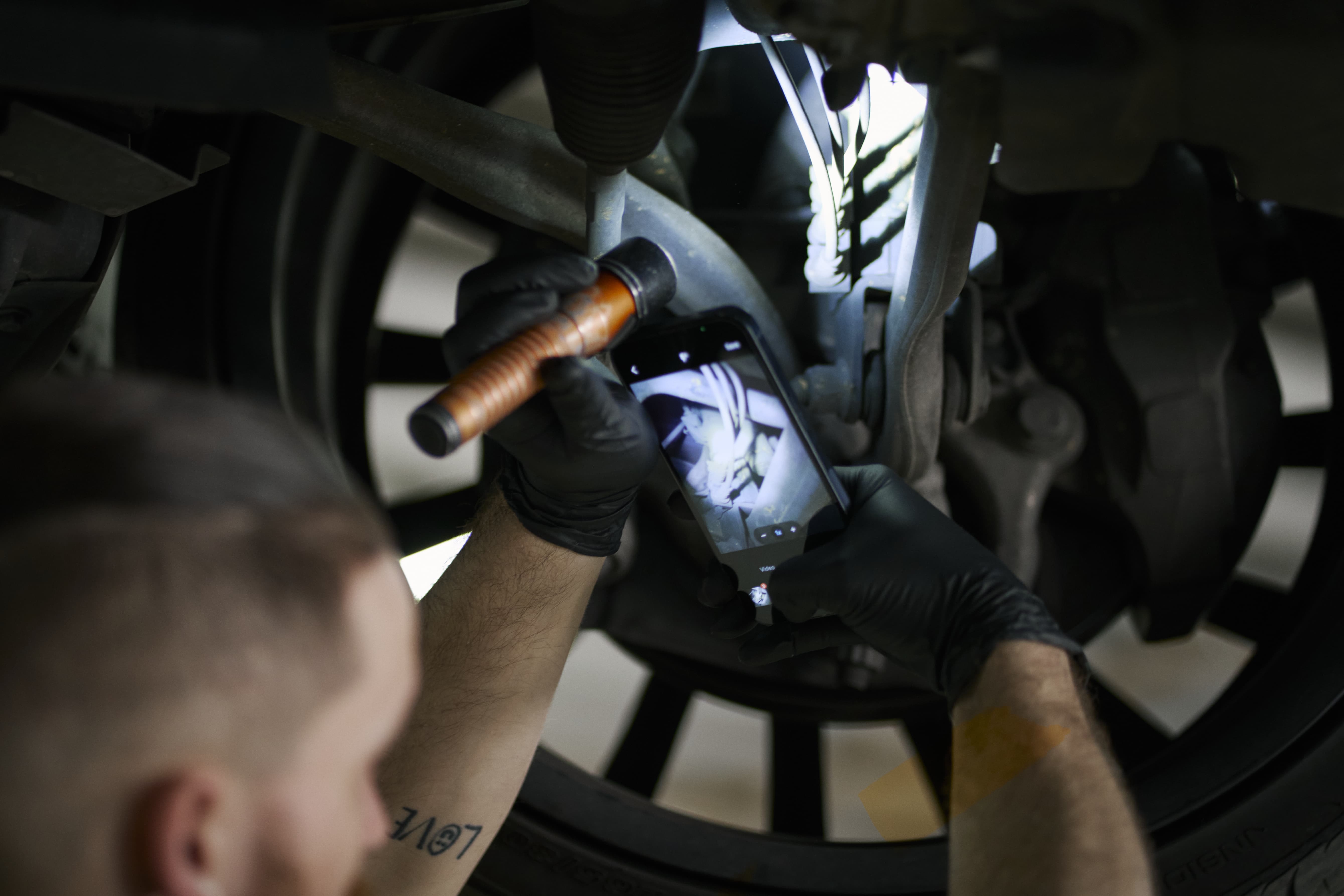
Table of contents
A technician pulls a wheel and finds a torn boot and grease flung across the inside of the rim. The adviser calls the customer. They describe a part the customer has never seen, on a vehicle the customer can't look at, and quote a price. The customer says they'll think about it, but has no basis on whether the work actually needs to be done.
Nothing in that exchange was wrong or dishonest. It asked someone to take a stranger's word for several hundred dollars, sometimes thousands. The hard truth is most people won't, and that is a common problem auto repair shops face. Customers have no way to evaluate shop recommendations.
Digital vehicle inspections, or DVIs, directly attack that gap. Technicians photograph and film what they find, the images are attached to the repair order, and the customer sees the problem before they make a decision. A DVI converts a claim the customer has to believe into something they can actually see. This drastically increases approvals and your average repair order.
Picture a shop that finds $1,200 of work on a car and only sells 55% of it. They leave $540 on the table, which is more common than you might think.
A 2026 Ratchet+Wrench Industry Survey found the most common closing ratio at auto repair shops is only 50% to 59%, meaning almost half the issues a shop finds are not repaired. That figure isn't the work the shop missed. It's work the shop found, wrote up, and failed to sell. Multiply it by your own monthly car count and you’ll see the opportunity in front of you.
That’s what DVIs are aimed at. DVIs substantially increase the work that’s approved on the repair order.
Start with what a customer carries into the lobby. In its December 2024 Gallup survey, only 35% of Americans rated the honesty and ethics of auto mechanics as high or very high. Roughly two in three people do not trust auto repair professionals.
That's the ceiling a service adviser works under. Two-thirds of the driving public doesn't put this trade in the top tier for honesty. That's the gap DVIs fill. They stop asking customers to extend trust to the auto repair industry and instead hand them evidence.
During DVIs, technicians document vehicle conditions with photos and short videos as the inspection happens, attach the findings to the repair order, and the customer reviews them. The customer can see things like a worn wheel, leaking fluids, and rundown belts, and approves or declines work line by line.
Evidence replaces description. Advisers stop narrating repairs over the phone and can point at issues. Approvals don’t rely on a brief conversation, and instead the shop sends the customer a link they can open in their free time. The inspection also becomes a permanent record rather than a conversation nobody wrote down. And declined work becomes a dated, priced list instead of something an adviser half-remembers three months later.
Adoption of DVIs is thin and auto repair shops have much room for improvement. The Ratchet+Wrench survey found only half, some 52% of shops, use an electronic inspection sheet. It is worth reading that number precisely: an electronic inspection sheet is a digital checklist, and a shop can run one without ever sending DVI images or videos to a customer. Given this information, less than half of the auto repair industry is using DVIs, if that.
J.D. Power's aftermarket research has separately found that nondealership shops are far less likely than franchised dealerships to include photos or video with an inspection at all.
Sharing photo and video inspection results by text more than doubles the likelihood that a customer approves recommended work. That comes from J.D. Power's 2026 U.S. Aftermarket Service Index.
Despite the fact DVIs drive additional business, the auto repair industry shows no meaningful improvement in providing documentation to customers. That gap is where opportunity lives.
The delivery method matters just as much as the DVI images and videos. More than half of aftermarket service customers in that study preferred texts for service updates.
There is corroborating evidence from franchised dealerships that DVIs boost business. Repair orders ran $65 higher on average among dealers who called multimedia inspection tools very impactful, according to Cox Automotive's 2023 Service Industry Study, which covered 2,493 vehicle owners and 525 franchised dealers. The trend can be adopted by aftermarket shops to boost their revenue.
The real question isn't whether a DVI helps recover hundreds of dollars in unsold repairs. It's how much of it a shop can actually pull back.
J.D. Power found the largest verified effect on record: DVIs more than double the odds a customer approves a repair. But that's not the same as doubling your closing ratio — no published research shows how one translates to the other.
Do the math on numbers you control. Say a shop finds $1,200 per car in needed work, and its closing ratio climbs 10 points. That's $120 more per vehicle. At 125 cars a month — a common volume in the Ratchet+Wrench survey — that's $15,000 extra a month with no additional cars, bays, technicians, or marketing spend.
That's the honest upside, and it's a big number.
You'll see bigger claims across the industry such as a 27% lift in average repair order or approval rates up more than 70%. These come from inspection software vendors citing the success of their own customers. Take them as a sign the ceiling of what’s possible is high.
The adviser's role shifts from describing to presenting. They are no longer building a case for a part the customer has never seen. They are answering questions about an image the customer is already looking at.
That's a different conversation, and it needs a different script. The adviser who reads all 18 inspection findings aloud in order has replaced one problem with another. Lead with what makes the vehicle unsafe today, name what can reasonably wait, and let the customer decide across a priced list.
Documentation is a compliance asset, and in some states, close to a requirement. California's Bureau of Automotive Repair requires a written estimate before work begins, prohibits work or charges before the customer authorizes them, and requires shops to retain repair records for three years. The U.S. Federal Trade Commission, which enforces federal consumer protection law, advises consumers to keep every estimate and repair order and to photograph a vehicle before and after service. A shop with timestamped images and a recorded line-by-line authorization is already holding the documentation both sides are told to keep.
That record does two jobs. It answers a customer who returns claiming damage the vehicle arrived with. And, it turns declined work into a follow-up list with dates and dollar amounts attached, which is the most underused asset in most shops.
Questions from the floor
Does a digital vehicle inspection (DVI) actually increase approval rates?
How much work is a typical shop failing to sell?
How long does a DVI add to each vehicle?
How many shops are running DVIs?
FILED UNDER
Shop Operations
THE PEOPLE BEHIND THE STORY
Kris Turner