Hello Shop Owners, Sunil Patel, Co-Founder of Tekmetric here.
I’m writing this blog because I believe it’s both an honor and a duty to be a leader in business.
Recently, I was awarded by Houston Business Journal as a Most Admired CEO of 2020, and this got me thinking about the leadership principles that have helped me along the way and made Tekmetric what it is today.
Not only do I lead a team of great talent, but I also speak with and have the pleasure of doing business with many strong leaders, whether it be shop owners, other entrepreneurs, or even other leaders within the company.
The fact of the matter is that I wouldn’t have been able to build a robust shop management software without my team. Watching them succeed and set each other up for success is hands down the most rewarding part of my job.
It’s a privilege to work with talented and innovative individuals that make me proud each and every day.
Playing a part in helping them grow and flourish makes me feel like I have served a purpose larger than simply building a product or making money.
Inspired by the HBJ honor, I took the time to sit down and outline a few of the leadership principles that I have always relied on.
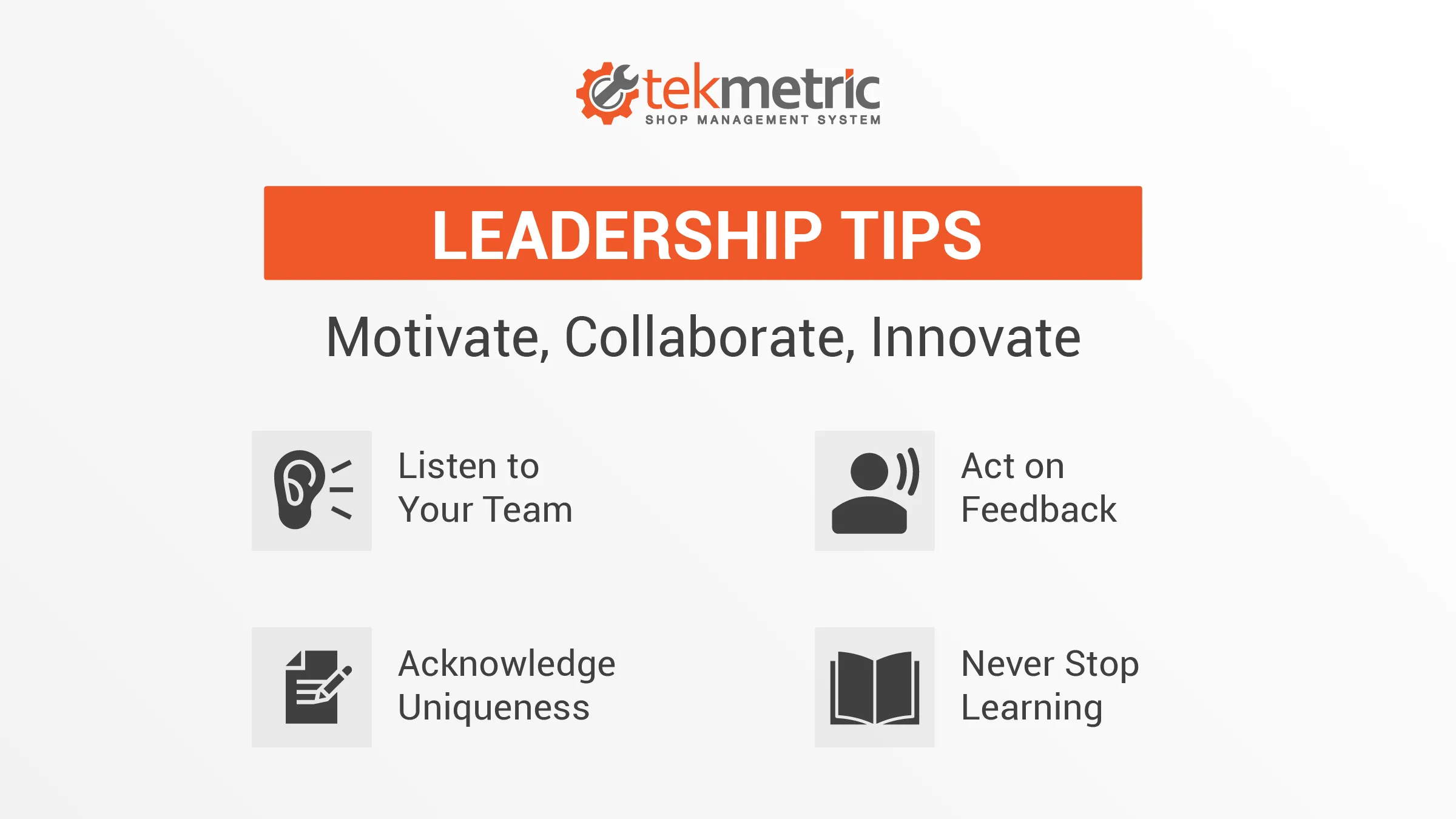
They focus on listening, learning, and recognizing everyone as an individual. I hope they help you and your team grow as people and as a unit.
1. Listen to Your Team
Good leadership relies on a strong feedback process.
Listen to your team, whether it’s an idea or how they’re feeling so that they know you care not only about their contributions but also about them as people.
Once a week, I sit down with the leaders of different departments and simply listen to how things are going. What are the current challenges they’re facing? What are some successes they’re proud of?
What do they feel they could use more support with? Giving them the room to voice their concerns, their desires, and their victories provide them with a model for being the best leader they can for the people they lead.
Even when we’re hiring new team members, we like to get input from our current team to make sure we’re considering all voices in the process.
No idea is a bad idea. Even the ideas that you never end up using still have value because they can spark other ideas, show your team a new perspective, or simply show the person who voiced them that they were included as part of the team or project.
2. Act on Feedback
Internal feedback is important, too. That’s how I came up with Tekmetric. When I owned and operated an auto repair shop, I realized that there was no easy way to check on things when I was away on vacation or at a conference.
I either had to call someone and ask them to read me the numbers or use a VPN and brute force my way into my own system. I thought, “This should be easier.”
I took note of those challenges, then asked myself how I might be able to solve them. I began developing a cloud-based shop management solution that could be accessible from anywhere.
My business partner Prasanth and I were able to develop a system that worked, but I realized I could keep innovating and make it better with feedback from other shop owners.
3. Acknowledge Individual Uniqueness
When you have a growing team, you start to notice the different strengths and tendencies of the people you work with.
Sometimes you have people who are capable of filling a whole marker board with ideas in a short amount of time.
Other people are much more measured and reserved, but when they say something aloud, you better listen, because they have powerful insights.
Your technicians know how to get to the heart of what’s going on with the vehicle, but one technician might do it a little differently than the next.
Your service advisors all know how to make sure guests are getting what they need, but the little differences in how they operate are all worth observing and learning from.
Everyone has their strengths and understanding what each person’s strengths make it easier to maximize their performance in their roles.
Even when we’ve implemented Tekmetric at large companies with hundreds of shops, drawing from the strengths of different players has been invaluable.
Corporate executive leaders have a macro-view of how things work that’s critical to our success, but equally critical are the perspectives of our own team members and individual franchise shop owners.
The people in the shop every day are the ones who make sure we don’t miss details, and that our system and all the systems it interacts with work for them as they serve their guests.
Input from everyone makes for a simple and easy switch.
No matter how someone thinks or expresses what they’re thinking, there’s something to be gained from every team member as long as you have an environment where everyone is respected and you have implemented a healthy feedback process.
4. Never Stop Learning
Feedback is on an ongoing process that never ends and always seeks more refinement.
Listening to ourselves, our team, and other shop owners continues to be crucial to ensuring that my business keeps innovating products that can outcompete similar products on the market and help shop owners scale up, be more profitable, and help as many people as possible.
These are just a few principles that we use, but I always encourage leaders to keep adding to and adjusting their mindset because we’re always going to run into new challenges.
What leadership principles do you use to guide your team, yourself, and your business?
Co-CEO and Co-Founder of Tekmetric Sunil Patel joined Editor Chris Jones on Ratchet+Wrench Radio to talk about how shop management software suites are changing the landscape of the auto repair industry, especially when it comes to building relationships and communicating effectively.
Sunil also touched on the history of some of Tekmetric’s relationships and how Tekmetric makes sure the voices of shop owners are heard.
Listen here, or catch some of the highlights below.
Note: some of the following answers have been condensed for clarity and brevity.
Relationship-Building 101: Laying Down a Solid Foundation
Jones: The last time we saw each other was at WorldPac STX in Orlando. And that’s where you guys announced a partnership with Advance Auto Parts. I know a lot of our readers have seen it, but can you share a little bit about the details with our audience, just from your own words and perspective?
Patel: So we’ve had a great relationship with Advance Auto Parts for a very long time. And we wanted to leverage the relationship to try to get more shops to use Tekmetric, and it just happened to be the right place, right time.
Side note: For those that don’t know, Advance Auto Parts actually owns WorldPac and Sunil Patel’s relationship with both goes way back. Before co-founding Tekmetric, Patel owned an auto repair shop that was one of the highest purchasers of parts from WorldPac in Houston for almost a decade.
Jones: That’s kind of cool to see how the relationship evolved over the years.
Patel: It’s a big company. It’s not like turning a speedboat, it’s like turning a steamship. Sometimes it just takes time to let some of these relationships play out. It affects so many people. We have to be absolutely sure of how this is going to play out, and how it’s going to work.
Using Shop Management Software to Get Everyone on the Same Page
Jones: So let’s talk about shop ownership a little bit. You were once a shop owner kind of in the Dark Ages before we had these robust shop management software suites. What was it like for you to operate on these limited tools?
Patel: You know, it was tough. Customers didn't always respond back, and we would always have to follow up with a phone call. There was always a disconnect.
We were probably ahead of our time 12 years ago trying to get some of this stuff out. Tekmetric used a combination of manual processes and text messaging. Text messaging was pretty popular back then, but MMS or multimedia messaging or picture messaging was not so popular.
So adding that in the mix with communications and whatnot into one platform has been very paramount to the success of our company because it closes the loop between the vehicle owner, the shop owner, the technician, and the service writer.
It keeps everybody on the same platform and communications thread. That way everybody has full visibility into what's going on with the repair of that vehicle to ensure a timely repair—ultimately making the customer happy.
Old habits are hard to break, especially when it comes to the physicality of handwritten notes.
A pen and a piece of paper can provide a better sense of security—they’re tangible and tactile. In our minds, we view paper as something we “own”, which makes it seem more reliable and easily obtainable.
But is pen and paper more reliable than digital tools?
Although the trusty pen and paper method does have perks, there’s a time and a place for everything. Which leads us to paper’s modern day competitor: digital software.
Switching paper out for a modern, digital format will enhance legibility, make archiving far easier than having file cabinets full of papers, and will strengthen collaboration across your team. Not to mention, you don’t run the risk of a fire or flood destroying your shop’s backed up data the way a natural disaster would with paper files and documents.
Now, this isn’t to say that digital software will replace every single piece of paper; however, software can successfully improve the efficiency of projects—especially when it comes to running an auto shop.
Let’s bring it back to the initial question: is automotive work order software a replacement for pen and paper? The rough answer is "yes," although there may be times where you still want to have paper as an option.
But many pen and paper tasks can be replaced, and should, for better productivity and organization. Automotive work order software can astronomically enhance your shop’s productivity and organization in ways that traditional methods cannot.
In your personal life, paper can take precedence in whichever way you wish. But in your shop, opting in for a digital system instead of pen and paper has more pros than cons.
Whether you're just getting started in the world of auto mechanics or you're a seasoned professional looking to sharpen your skills, having the right books in your toolkit can make a world of difference.
In this guide, we’ve rounded up the best 10 books for anyone looking to master automotive repair—five books for beginners and five for professionals. Whether you're diving into DIY oil changes, understanding electrical systems, or prepping for ASE certification, these books can help you become the car mechanic others rely on.
Top 5 Mechanic Books for Beginners
1. Auto Repair For Dummies by Deanna Sclar
Deanna Sclar, a trusted name in car books, breaks down automotive repair in a clear, engaging way. Topics include basics like changing oil, identifying car parts, and performing simple diagnostics. Updated editions also include guidance on hybrid and electric vehicles.
This book is great for high school students, DIY car owners, and anyone who wants to enhance their car repair knowledge. It teaches vehicle maintenance fundamentals and gives you the confidence to handle everyday car repair tasks.
This book is available in paperback and audiobook format on Amazon and Goodreads.
2. How Cars Work by Tom Newton
“How Cars Work” is an illustrated mechanics book designed to make complex automotive technology digestible. It covers everything from internal combustion engines to carburetors using simple diagrams and descriptions.
Ideal for visual learners and those completely new to auto mechanics. This is a great first book for beginners, high school students, and anyone wanting a strong visual foundation. This book is available at Amazon, Goodreads, and Walmart.
3. Service Repair Manuals
Service repair manuals offer detailed, step-by-step instructions specific to various makes and models. Whether you're working on a Chevy or a lawn mower, there's likely a repair manual for it.
These manuals walk you through every procedure—from basic maintenance to full rebuilds—making them excellent for DIY mechanics. The manuals are great for car owners who want to perform their own maintenance and repairs, especially oil changes and part replacements.
4. Auto Repair and maintenance for Beginners by Dave Stribling
This is a more recent release that blends practical guidance with a conversational tone. It’s designed for car owners who want to understand what’s under the hood without going back to school.
It breaks down diagnostics, basic electrical systems, and essential car repair projects with clarity and confidence. DIYers, automotive technology students, and anyone just entering the field will benefit from this resource. This book is available on Amazon and Target.
5. ASE Study Material
While not a traditional repair resource, these ASE guides cover specific topics you may be interested in. In addition, these resources can also help you study for your ASE exams/certification. These study guides cover everything from refrigerant to engine diagnostics.
These resources are great for beginners looking to become ASE certified or just want to deepen their technical knowledge of car repair. You can find these ASE resources on the ASE website.
Top 5 Mechanic Books for Professionals
1. Automotive Technology: A Systems Approach by Jack Erjavec & Rob Thompson
Used in technical schools and ASE training programs, this comprehensive study guide covers every vehicle system in detail. From brakes to diagnostics and internal combustion engines, it’s a powerhouse of professional knowledge.
Excellent for instructors, professional auto mechanics, and shop technicians. It’s also used as a curriculum base in many accredited auto mechanic programs. This book can be found on Amazon and Goodreads.
2. Engine Repair (A1) – ASE Test Prep Study Guide by Delmar Cengage
If you’re serious about becoming ASE certified, this study guide is one of the best tools to prep with. It’s focused on the A1 Engine Repair certification exam and is updated with the latest questions and procedures.
It contains practice questions, answer keys, and step-by-step breakdowns of engine troubleshooting and repairs. Mechanics pursuing ASE certification and current techs looking to refresh their credentials will benefit from this book.
3. Bosch Automotive Handbook
This is not your average repair manual. The Bosch Automotive Handbook is a dense, technical reference filled with precise definitions, formulas, and design principles behind modern vehicle systems, including electrical systems and diagnostics.
A must-have for those working on diagnostics or developing automotive systems. Not ideal for beginners, but invaluable for seasoned pros. This book is available on Amazon.
4. Advanced Automotive Fault Diagnosis by Tom Denton
Tom Denton is a trusted author in the world of automotive technology. This book focuses on advanced diagnostics using real-world case studies and troubleshooting processes.
It covers OBD systems, scan tools, sensor data interpretation, and diagnostics strategies used in modern repair shops. ASE certified professionals, diagnostic techs, and repair shop leads will appreciate this book. This book is available at Walmart and Amazon.
5. Motorcycle Basics Techbook by Matthew Coombs (Haynes)
Auto mechanics often expand into motorcycles. This Haynes book explores motorcycle maintenance and repair with the same detail they bring to their car repair manuals.
Great for mechanics who want to branch into motorcycle repair or work at specialized repair shops. This book is available on Amazon and Thriftbooks.
Other Mechanic Resources
While books are still relevant, many mechanics have transitioned to other resources like YouTube videos and podcasts. Here are some of our favorites.
YouTube
YouTube is a gold mine for car repair veterans and DIYers alike. Some of our favorite channels include:
Enright Auto - for new tools and repair techniques
Reddit can be another powerful resource for new techniques plus an online community to answer questions you may have. Some of the best subreddits include:
Investing in a good book isn’t just about reading—it’s about building your skills, your confidence, and your future in the automotive industry. Whether you’re just learning how cars work or studying classical mechanics principles, there’s a resource here that can guide you. The best mechanics know that their education never stops.