Hello Shop Owners, Sunil Patel, Co-Founder of Tekmetric here. I’m writing this blog because I believe it’s both an honor and a duty to be a leader in business. Recently, I was awarded by Houston Business Journal as a Most Admired CEO of 2020, and this got me thinking about the leadership principles that have helped me along the way and made Tekmetric what it is today.
Not only do I lead a team of great talent, but I also speak with and have the pleasure of doing business with many strong leaders, whether it be shop owners, other entrepreneurs, or even other leaders within the company.
The fact of the matter is that I wouldn’t have been able to build a robust shop management software without my team. Watching them succeed and set each other up for success is hands down the most rewarding part of my job. It’s a privilege to work with talented and innovative individuals that make me proud each and every day. Playing a part in helping them grow and flourish makes me feel like I have served a purpose larger than simply building a product or making money.
Inspired by the HBJ honor, I took the time to sit down and outline a few of the leadership principles that I have always relied on. They focus on listening, learning, and recognizing everyone as an individual. I hope they help you and your team grow as people and as a unit.
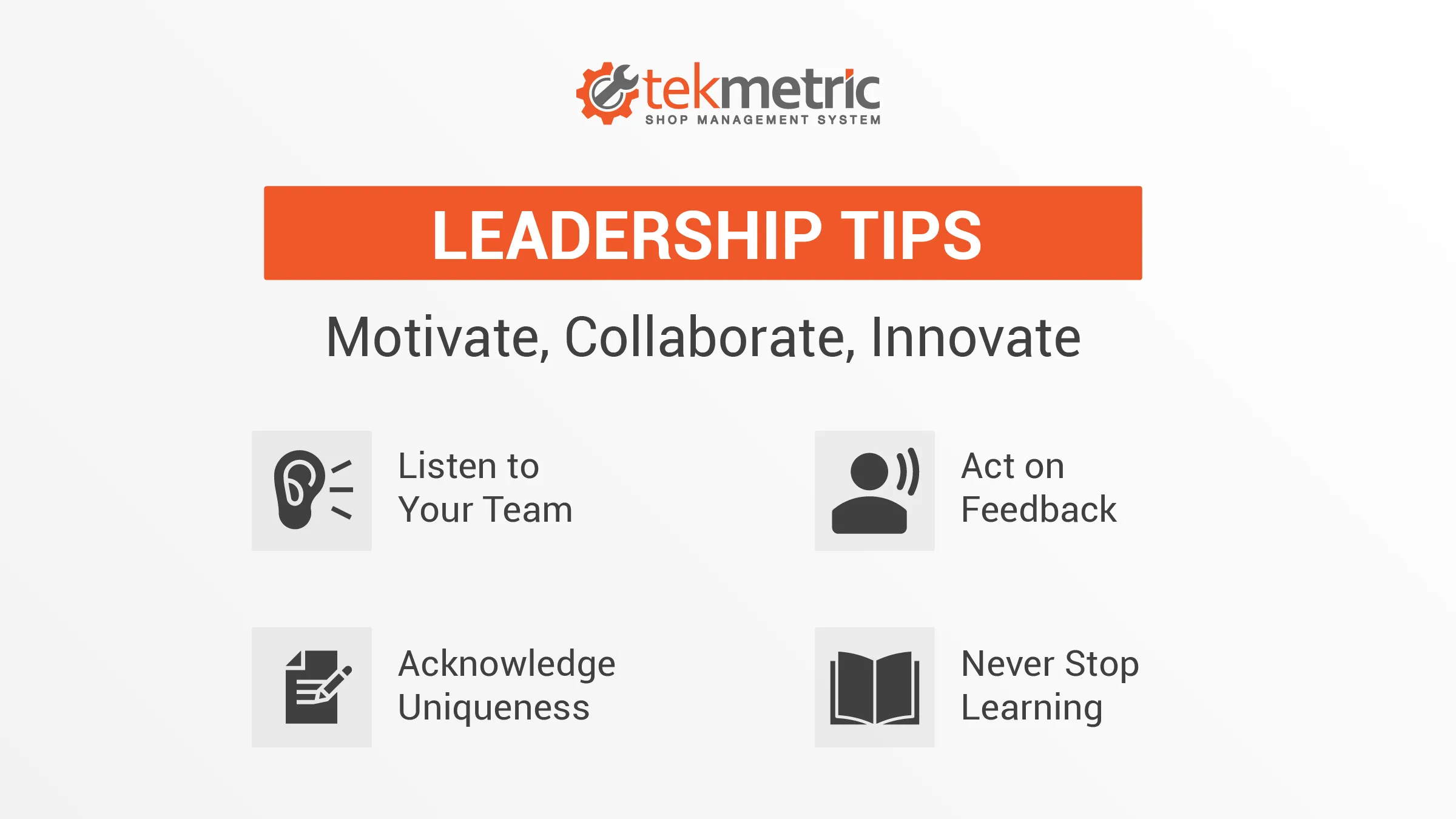
1. Listen to Your Team
Good leadership relies on a strong feedback process. Listen to your team, whether it’s an idea or how they’re feeling so that they know you care not only about their contributions but also about them as people.
Once a week, I sit down with the leaders of different departments and simply listen to how things are going. What are the current challenges they’re facing? What are some successes they’re proud of? What do they feel they could use more support with? Giving them the room to voice their concerns, their desires, and their victories provide them with a model for being the best leader they can for the people they lead. Even when we’re hiring new team members, we like to get input from our current team to make sure we’re considering all voices in the process.
No idea is a bad idea. Even the ideas that you never end up using still have value because they can spark other ideas, show your team a new perspective, or simply show the person who voiced them that they were included as part of the team or project.
2. Act on Feedback
Internal feedback is important, too. That’s how I came up with Tekmetric. When I owned and operated an auto repair shop, I realized that there was no easy way to check on things when I was away on vacation or at a conference. I either had to call someone and ask them to read me the numbers or use a VPN and brute force my way into my own system. I thought, “This should be easier.”
I took note of those challenges, then asked myself how I might be able to solve them. I began developing a cloud-based shop management solution that could be accessible from anywhere. My business partner Prasanth and I were able to develop a system that worked, but I realized I could keep innovating and make it better with feedback from other shop owners.
3. Acknowledge Individual Uniqueness
When you have a growing team, you start to notice the different strengths and tendencies of the people you work with. Sometimes you have people who are capable of filling a whole marker board with ideas in a short amount of time. Other people are much more measured and reserved, but when they say something aloud, you better listen, because they have powerful insights. Your technicians know how to get to the heart of what’s going on with the vehicle, but one technician might do it a little differently than the next. Your service advisors all know how to make sure guests are getting what they need, but the little differences in how they operate are all worth observing and learning from. Everyone has their strengths and understanding what each person’s strengths make it easier to maximize their performance in their roles.
Even when we’ve implemented Tekmetric at large companies with hundreds of shops, drawing from the strengths of different players has been invaluable. Corporate executive leaders have a macro-view of how things work that’s critical to our success, but equally critical are the perspectives of our own team members and individual franchise shop owners. The people in the shop every day are the ones who make sure we don’t miss details, and that our system and all the systems it interacts with work for them as they serve their guests. Input from everyone makes for a simple and easy switch.
No matter how someone thinks or expresses what they’re thinking, there’s something to be gained from every team member as long as you have an environment where everyone is respected and you have implemented a healthy feedback process.
4. Never Stop Learning
Feedback is on an ongoing process that never ends and always seeks more refinement. Listening to ourselves, our team, and other shop owners continues to be crucial to ensuring that my business keeps innovating products that can outcompete similar products on the market and help shop owners scale up, be more profitable, and help as many people as possible.
These are just a few principles that we use, but I always encourage leaders to keep adding to and adjusting their mindset because we’re always going to run into new challenges.
Let’s start off by laying down the foundational launching points for starting your original shop: you found your niche, you got the right advice, you started with the right branding, and you impressed your customers by providing exceptional customer service. But there are four key factors that become extremely important as you go from being a single shop owner to a multi-shop owner.
You’ll want to:
Stay organized as you scale
Create consistency across your locations
Test the performance of each of your locations
Leverage an automotive repair software that will support your team as you grow across multiple locations
To select the management tools that will catapult your multi-shop owner journey, you’ll first need to weigh the pros and cons of each of your shop’s processes and procedures.
From there, you can find a system that will uphold and scale the processes that made your shop so successful in the first place, but now across multiple locations. Later in this article, we’ll specifically dive into automotive repair software like Tekmetric and discuss how it supports you, your team, and your customers as you go from a single shop owner to a multi-shop mastermind.
Here’s how to choose an automotive repair software that makes it possible to grow and easily manage multiple shops.
Here, we explore the importance of service writers for an auto center or dealership. By the end, you'll have a comprehensive understanding of the service writer role, the qualifications they need, and what to look for when you’re hiring.
What is an automotive service writer?
A service writer is the liaison between the customer and the repair garage. Sometimes called a service advisor or coordinator, they run the front desk and interact directly with your customers. The service writer is essentially the face of the business, and they fulfill several duties that keep the service center functional.
What does an automotive service writer do?
Service writers do a lot for a repair center. Here are some of their main duties:
Delivering exceptional customer service
Coordinating and managing service appointments
Monitoring and overseeing vehicle maintenance and repairs
Maintaining accurate records of customer and vehicle data
Generating service cost estimates for customers
Facilitating effective communication between customers and technicians
Handling billing transactions and manage financial records
The duties of a service writer typically depend on their qualifications. Understanding the foundational credentials can help you choose the right candidate for your maintenance center.
Repeat jobs are common in auto repair work. How often does a customer walk in and ask for something common like an oil change or a tune-up? Or does your shop specialize in one type of vehicle, and you're constantly handling the same repairs?
What if we told you we could help you build those most common repair orders in a matter of seconds? That way your service writers can focus on providing amazing customer service every time.
Because let’s face it, regardless of the job, your customers are relying on your team to provide the same quality experience they're used to in so many other industries. And if you own multiple shops, then your customers are expecting you to provide the same quality of service at each location.
Canned jobs make it easy for your shop to not only save time when building estimates and serving customers but also make it easy to provide a consistent and smooth customer experience -- in the end making your shop even more money by boosting your shop's average repair order.



-min.webp)


.svg)


.svg)

.svg)
.svg)
.svg)
.svg)
.svg)
.svg)