Inventory can include items like oil, tools, and large equipment. It also includes stock items, or parts which are sold to the customer during the course of repairs, such as gaskets and timing belts.
Inventory management and parts management go hand in hand, but outside of labor profits, the profit a shop brings in ultimately comes from parts markup at the point of sale. Consequently, there’s very little room for error in managing parts.
Simply put, mismanaged parts means money left on the table and unhappy customers—a combination no shop owner or automotive team wants to experience.
A good auto parts inventory management system should let you:
• Know what parts you have in stock and how many you have
• Track what sells and what sits on the shelf longer than it should
• Help you plan for growth.
With the right auto parts inventory management system, your shop can go from disorganized to a well-oiled machine generating more and more profit.
How to know when it’s time to update your auto parts inventory management system
What are some indicators that your auto parts inventory management could use a tune up? And when should you start looking into shop management systems like Tekmetric? Here are some indicators to look for:
1. Overstocking Parts
It is easy to overestimate the demand for a specific part, especially if you are ordering parts between seasons, ordering specialty parts, or still using pen and paper or a spreadsheet to calculate your inventory.
Whatever the cause, it is important to remember that every part has a carrying cost. You can think of “carrying cost” as the storage cost for a part. Every part that sits on a shelf and occupies space that better selling products could take up costs your business money.
2. Parts Shortage
If you’re constantly running out of supplies, your auto parts inventory management system is failing. Good parts management requires staying ahead of the curve to anticipate the needs of your shop.
If you are always running out of parts and having to order them before you can complete a job, jobs will take longer, you’ll wind up paying more for parts, and you may lose your customers’ trust.
3. You're wasting time finding parts!
Whether the problem is a shortage or overstocking, either way your shop is spending too much time managing inventory ineffectively! If inventory management has become a dreaded task at your shop simply because it takes so long to complete, it is time to upgrade your system.
Inventory management must be a smooth process if you want the rest of your shop to operate efficiently. If regular check ups on your auto parts inventory are taking too long, it is probably a sign of a larger underlying problem—disorganization.
Own Your Parts Inventory With a Cloud-Based Shop Management System
You can’t run a shop without the right parts and tools, and in today’s automotive industry. Cloud-based shop management systems not only simplify your shop's operations, they even make it easier to make more money!
1. Direct Integrations with Parts Vendors
With immediate access to your favorite vendors directly inside Tekmetric, service writers can instantly find what they need.
Even better, because you an integrate multiple vendors, your shop can compare prices to get the best deal, and place an order in a matter of seconds.
2. Complete Inventory Management - From Anywhere
Track the flow of parts in your shop with Tekmetric's Inventory that connects to repair orders, estimates, and more. If you don't have a part in stock while working on a car, quickly swap the part for a similar one in inventory.
And because your shop management system is in the cloud, you can access your shop's parts inventory and do everything you could in your shop right from your phone or tablet. Literally, you can log in from anywhere in the world you have an internet connection to gain complete access to your shop remotely.
3. Create parts matrices to apply the right mark-up every time
By building streamlined process for marking up parts, shops can ensure grow your shop’s profit margin while staying fair to customers.
Fine Tune Inventory Management with Tekmetric
Whether you need to track down a stray steering column or make a decision about how much to invest in A/C repair parts for the summer, Tekmetric is your go-to system for gaining a better understanding of how parts move through your shop.
With Digital Vehicle Inspections shops can go the extra mile and introduce a new level of transparency through a frictionless experience for the customer.
They can get clear pictures or videos to show them what's wrong, have the inspection results sent to their email, and approve or decline work with just the click of a button.
However, while this is super simple for the customer, for Service Advisors, finding the right inspection can be time-consuming. Especially when your shop is training new service advisors and introducing them to your standard operations.
To save your Service Advisor's time and effort, we are excited to announce our newest feature: Default Inspections.
This feature streamlines the inspection process and makes it easier for you to provide great service to your customers.
Almost 1,000 shop owners, service advisors, and technicians gathered in Houston for Tektonic 2026, Tekmetric's first industry conference. Over two days at the Marriott Marquis, attendees packed breakout rooms, traded hard-earned lessons, and heard from operators, coaches, and industry leaders who have built and scaled shops of their own.
The Question That Started It All
Tekmetric CEO and Founder Sunil Patel opened Tektonic 2026 with a question he has been asking since he was writing service tickets and mopping floors at his former Houston shop, Motorwerks of Houston: "Why does it have to be so hard? Why does it have to feel like we're fighting a war on 12 fronts?"
That question, he told the room, is the reason Tekmetric exists.
Standing in front of shop owners, service advisors, and technicians who understand that question on a cellular level, Patel walked through how much harder running a repair shop has become. Vehicles are packed with software, sensors, and calibration systems that require entirely new toolsets. Customer expectations have been shaped by on-demand everything. Technician shortages continue to press on shops across the country. And OEM data restrictions are making it harder for independent shops to do the work they were built to do.
But Patel didn't stop at the challenge. He laid out four pillars he believes the industry needs to move forward: stop celebrating burnout as a badge of honor, build genuine trust with customers and teams, invest in an ecosystem of great partners and vendors, and embrace technology that serves shops rather than extracts from them.
He closed with a simple ask for everyone in the room: be curious, be open, be generous with what you know, and be present.
"I want you to take something away from here," he said. "Something that will get you to be 1% better than you were."
That set the tone for everything that followed.
Top Takeaways
Process Consistency Wins on the Hard Days
Busy days don't create problems. They expose them. The best shops build their standard operating process before the chaos starts.
Call the day before. A preappointment call to review service history and flag overdue maintenance turns intake from reactive to planned and primes customers to say yes before they walk in the door.
Speed is your biggest sales tool. Every hour between drop-off and delivering an estimate costs roughly 10% in approval rates. Get findings to customers fast.
Set the next promise, not the finish line. Never promise a completion time you can't guarantee. Promise the next specific update and deliver it on time, every time.
The in-store customer is the highest-priority repair order in the building. Every other car can wait. The person sitting in your lobby cannot.
Improve one thing at a time. Pick one process to fix, measure it, and build accountability before moving to the next. Trying to fix everything at once fixes nothing.
Speed Closes More Jobs Than Salesmanship
Closing rates drop sharply with every hour that passes between drop-off and the customer call. A customer who has been waiting since 8 a.m. has had time to read every one-star review and talk themselves out of approving the work.
Get inspection results to customers within 30 minutes of dispatch. That's the speed zone. Everything else in the shop is secondary until that call is made.
In-store customers get findings in 15 minutes or less. The customer is sitting right there. Use it.
Relative priority is your daily compass. At any moment, the most important thing is moving the car that's furthest behind in the process. Not the loudest customer. Not the most expensive ticket. The earliest step.
Two daily goals. Full stop. Every technician runs at least eight billable hours. The shop hits its gross profit target. Nail both and everything else follows.
You Don't Have a Technician Shortage. You Have a Culture Problem.
The technician pipeline isn't as broken as it seems. What's broken is how many shops make it hard to stay.
Rethink flat rate. Hybrid pay models that combine a solid base with performance incentives align your team's goals with the shop's goals and they're far more attractive to the next generation coming into the trade.
Answer two questions before you do anything else. Why would a technician work here? Why would a customer come back? If you hesitate on either, start there.
Recognition is the highest-ROI leadership move you have. Research cited at the conference found that team members become disengaged because they don't feel seen. Fix that before you invest in anything else.
AI won't replace hospitality. Technology can handle administrative weight, but the trust a service advisor builds with a customer at the counter is irreplaceable. Invest in that skill set.
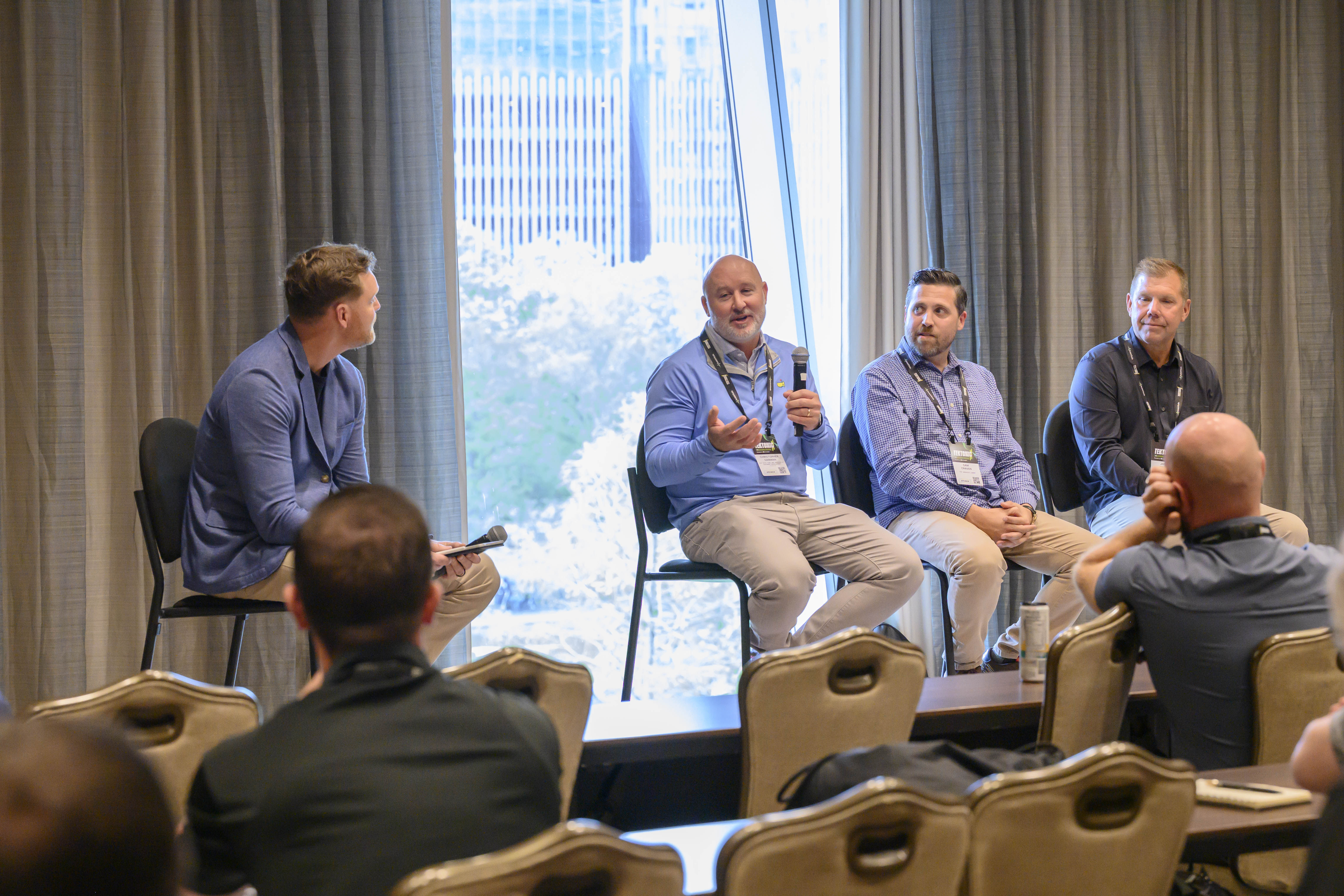
P.J. Leslie, Tekmetric's head of mid-market and enterprise sales, moderates a panel during Tektonic 2026 in which multishop owners break down the real strategies behind expansion: buying shops, building shops, systemizing operations, integrating teams, protecting culture, and planning for eventual exit or partnership.
Growing to Multiple Locations Takes More Than Money
Every multishop operator on the stage agreed: you're never fully ready, and that's fine. What matters is being profitable, having the right people, and expecting the unexpected.
Profitable and cash-positive before you move. When you make a mistake at location two—and you will—you need a healthy location to cover it.
You're ready when your shop doesn't need you. Build your bench before you open the next door. The manager for location two should already be in your building today.
Start your exit plan on day one. Almost no one in the room at one of Tektonic’s breakout sessions had a clear exit strategy. Don't leave money on the table because you never thought through how the story ends—whether that means selling, transitioning, or building for long-term cash flow.
Leadership Is the Ceiling on Everything Else
Your shop will never outperform your leadership. What you tolerate becomes your standard. How you show up on Monday morning sets the emotional temperature for everyone around you.
Know your triggers before they know you. Name what sets you off. Once you can spot it, you can stop it before it damages a relationship.
Pause for three seconds. Before you respond to anything that's gotten under your skin, stop. Three seconds is the difference between a reaction and a response.
Hear less. Listen more. After someone finishes speaking, let the silence sit. People almost always have more to say and the second thing is usually the real thing.
Walk into hard conversations knowing how you want them to end. Start with the outcome in mind, not the grievance.
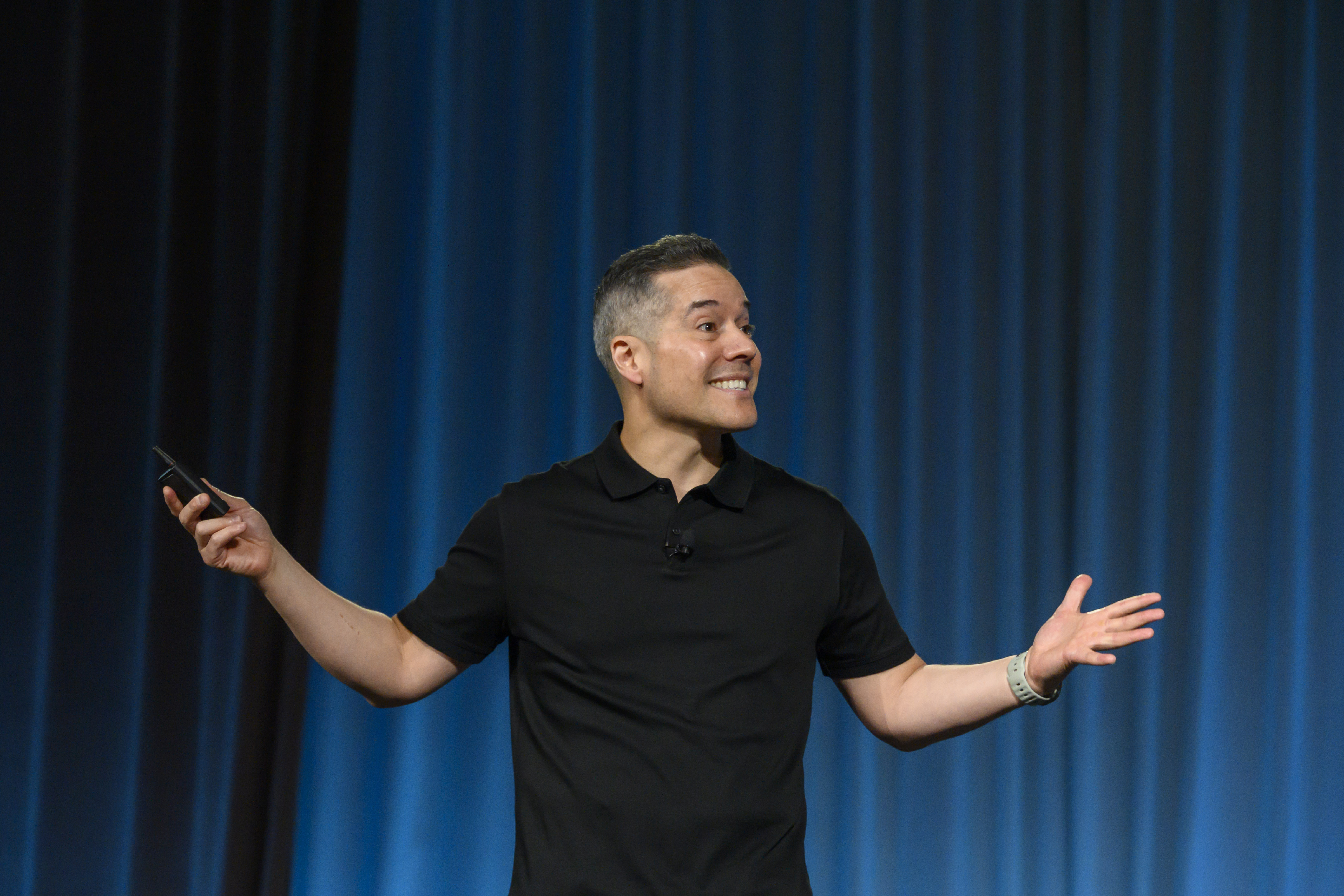
Tekmetric Chief Product Officer Jared Haleck breaks down Tekmetric's new products at Tektonic 2026. The new products include Tekmetric digital ads, Smart DVI, and Tekmetric phones.
Product Announcements at Tektonic 2026
The closing session belonged to the Tekmetric product team. Drawing on data from more than 15,000 shops on the platform, Tekmetric President and COO Lauren Langston and Chief Product Officer Jared Haleck built the roadmap around key areas where winning shops consistently outperform the rest: car count, average repair order (ARO), driver experience, and cycle time.
Here's a look at what’s coming:
Tekmetric Digital Ads: AI-powered advertising on Google Maps and Search, built for the moment a driver has a problem and is ready to act. It connects directly to Tekmetric so you can see the gross profit behind every dollar of ad spend, not just clicks.
Smart DVI: Technicians walk the vehicle, narrate what they see, and Smart DVI builds the customer-ready inspection report automatically—findings organized, images annotated, and jobs pre-suggested for the estimate. Less time typing. More time turning wrenches.
Tekmetric Phones: Customer details, open repair orders, and communication history surface the moment an inbound call rings. No more looking it up while someone's waiting. A future capability in development will transcribe calls in real time and auto-populate appointment notes.
See You in 2027
Tektonic 2026 was Tekmetric's first industry conference, and it delivered on the promise Sunil Patel made from the stage: a room full of shop owners, service advisors, and technicians who showed up to get better.
The through-line across every session was the same. The shops that win are the ones that build systems, invest in their people, and keep getting 1% better. Not all at once. One thing at a time.
Tekmetric Marketing now builds ready-to-send campaigns. The message is written and the audience is selected. All that's left is to review, personalize, and send.
Most shop owners know the fastest way to fill this week’s bays is by bringing back customers who already trust them — the ones whose vehicles you serviced months ago but haven’t seen since. Re-engaging existing customers is one of the most effective ways to generate new repair orders.
The problem is finding the time to do it. Figuring out what to send, who to send it to, and when to send it almost always loses out to the car on the lift or the customer standing at the front counter
That's where Tekmetric Marketing's Recommended Campaigns come in.
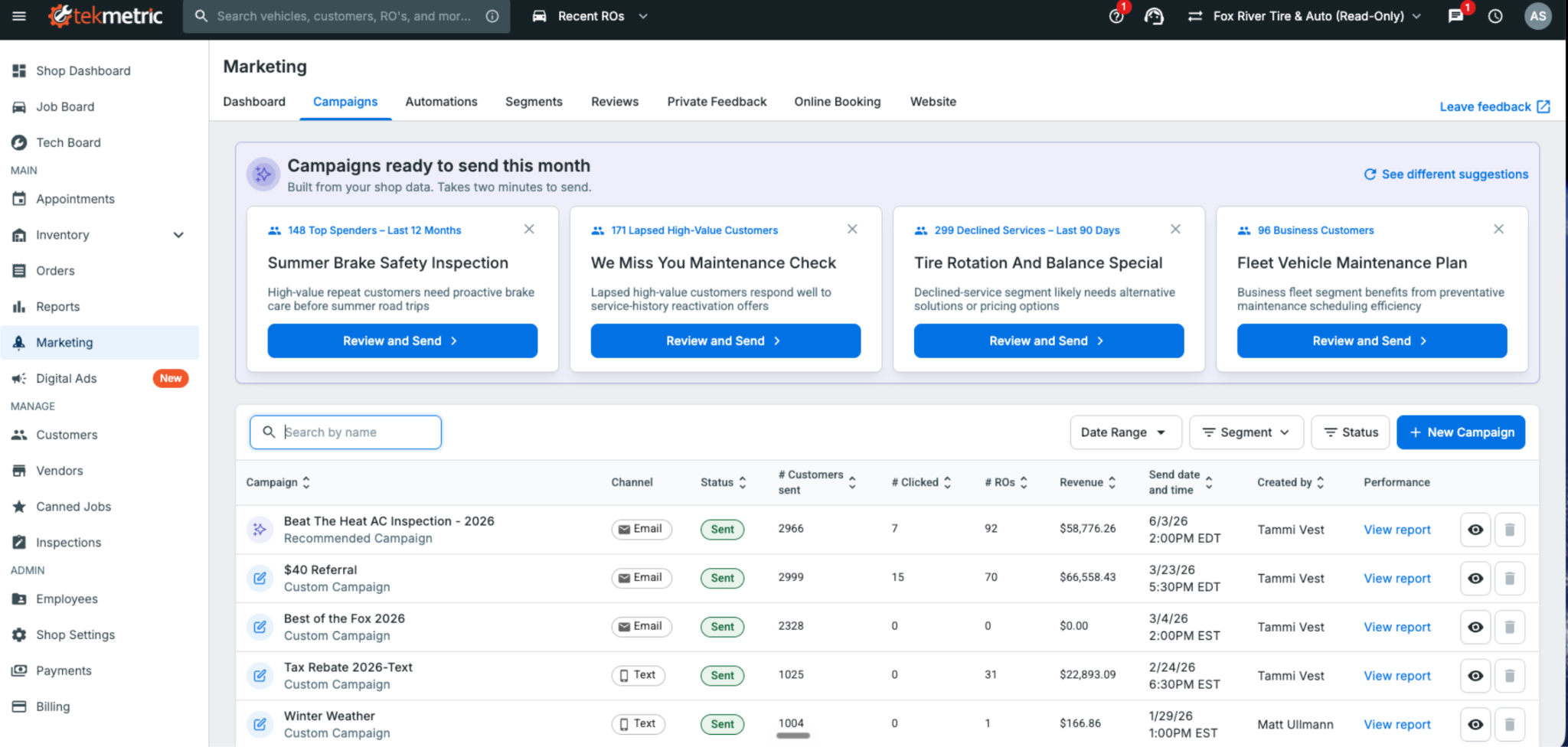
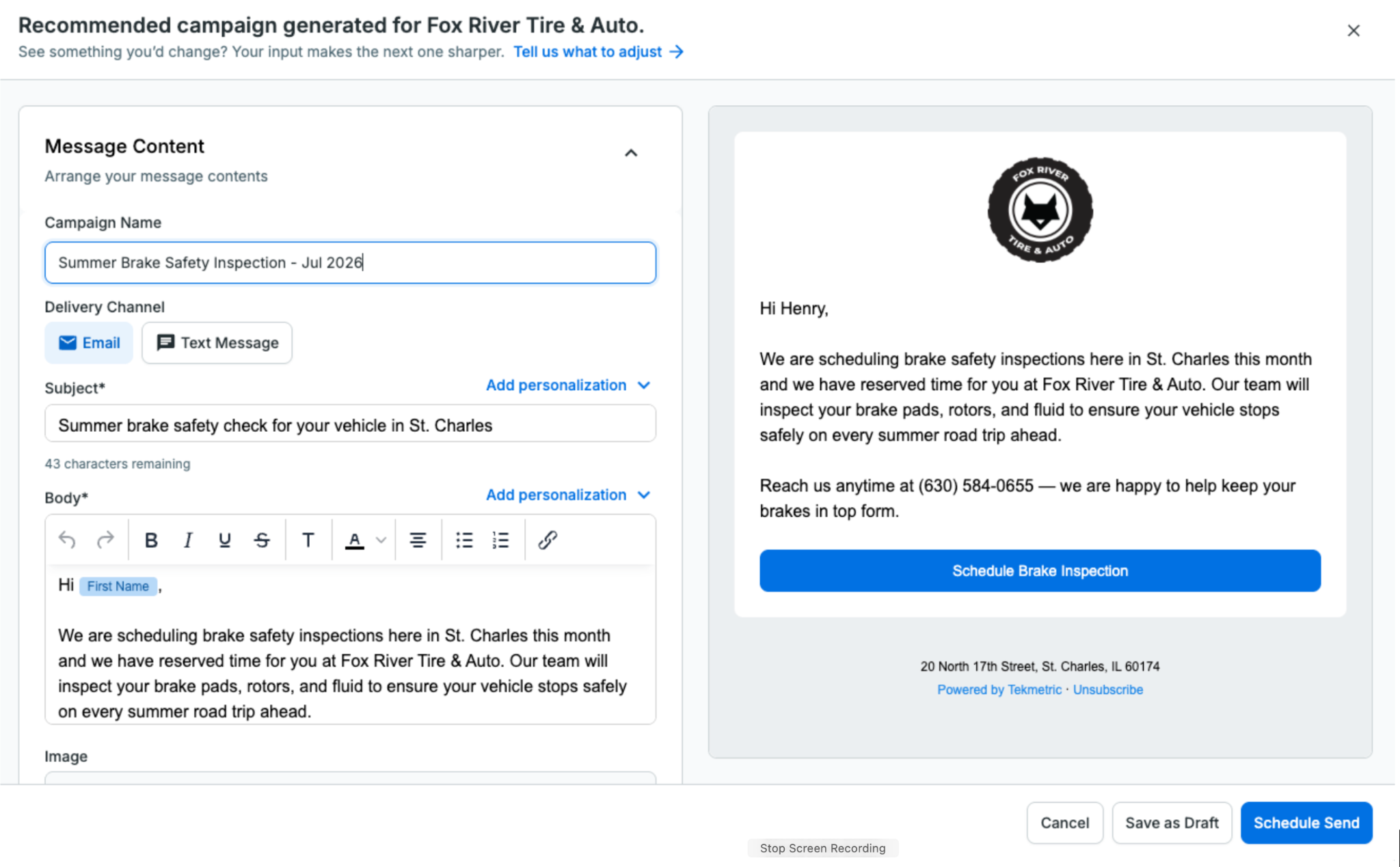
Instead of starting with a blank page, Tekmetric Marketing does the heavy lifting for you. It analyzes your shop’s data and recommends campaigns that are ready to go. The audience is selected, the message is drafted, and all that’s left is for you to review it, make any changes you’d like, and send.
No blank screen. No guesswork.
Just a campaign ready to help bring customers back.
How It Works
Recommended Campaigns automatically surfaces ready-to-send campaigns tailored to your shop using the information Tekmetric already knows — your customers, previous campaigns, location, and seasonality.
You’re always in control.
Review the recommendation, personalize the message so it sounds like your shop, adjust the audience if you’d like, choose when to send it, and you’re done.
What used to take an hour staring at a blank screen can now be done in just a few clicks.
How Fox River Tire & Auto Uses Recommended Campaigns
Like most shops, Fox River Tire & Auto in St. Charles, Illinois, wants to stay connected with customers and bring them back when the time is right. But deciding what campaign to send, then building it from scratch, takes time most shops don't have.
Recommended Campaigns gives Tammi and her team a starting point instead of a blank page. They review the recommendations, edit the suggested content to fit their brand, and send with confidence.
"Recommended Campaigns provide an excellent launchpad for re-engaging with our customers. Instead of starting from scratch, we refine the suggested content to fit our brand and send it with confidence. The process is straightforward, time-saving, and always delivers."
— Tammi Vest, Business Manager, Fox River Tire & Auto
From Reports to Results
Recommended Campaigns is part of a much bigger shift in where Tekmetric Marketing is headed.
For years, marketing platforms have been good at showing you what already happened: campaign reports, open rates, clicks, and dashboards. That’s valuable, but it still leaves the work on you.
Tekmetric Marketing is evolving beyond reporting. Increasingly, it’s helping you decide what to do next, and doing more of the work for you.
You’ve already seen this with Recommended Review Responses. When a customer leaves a Google review, Tekmetric drafts a thoughtful response for you to review and approve.
Recommended Campaigns is the next step.
Instead of simply telling you that you should market to your customers more often, Tekmetric Marketing puts a campaign directly in front of you — already drafted, targeted, and ready to send.
Your marketing should keep working even while you’re heads-down under a hood.
One Year of Continuous Innovation
Since launching Tekmetric Marketing in the fall of 2025, thousands of shops have made it part of how they attract new customers and bring existing ones back.
We’ve also continued investing in the platform based on feedback from shops like yours.
Recent additions include:
Rich text and custom links in every email so you can create more engaging emails and link directly to booking pages, review sites, and promotions. Bold a headline, organize services into a list, and drop in links to your booking page, review site, or a promotion, in both campaigns and automated emails like review requests and service reminders.
Recurring blocks for your calendar for lunch breaks, holidays, staff meetings, and other recurring events. Easily add recurring lunch blocks, staff meetings or holidays to your calendar with a few clicks. No more appointments booked over your team events without you knowing.
Smarter marketing-source tracking on appointments and ROs: Automatically associate appointments and repair orders with the latest marketing campaign or automation that reached the customer. When a customer books after getting a message, the marketing source pre-fills with the most recent campaign or automation sent to them, so attribution is accurate without the guesswork.
Recommended Review Responses, helping you respond to Google reviews in just a few clicks.
Every one of these improvements started with feedback from shop owners looking for simpler, smarter ways to grow their business.
Keep it coming.
Already using Tekmetric Marketing?
Head to Marketing → Campaigns to see what's recommended for your shop and send your first campaign in just a few clicks.
New to Tekmetric Marketing?
See how Tekmetric Marketing helps shops bring customers back with online booking, automated reminders, review generation, and Recommended Campaigns.





.svg)


.svg)

.svg)
.svg)
.svg)
.svg)
.svg)
.svg)