Here, we explore the importance of service writers for an auto center or dealership. By the end, you'll have a comprehensive understanding of the service writer role, the qualifications they need, and what to look for when you’re hiring.
What is an automotive service writer?
A service writer is the liaison between the customer and the repair garage. Sometimes called a service advisor or coordinator, they run the front desk and interact directly with your customers. The service writer is essentially the face of the business, and they fulfill several duties that keep the service center functional.
What does an automotive service writer do?
Service writers do a lot for a repair center. Here are some of their main duties:
Delivering exceptional customer service
Coordinating and managing service appointments
Monitoring and overseeing vehicle maintenance and repairs
Maintaining accurate records of customer and vehicle data
Generating service cost estimates for customers
Facilitating effective communication between customers and technicians
Handling billing transactions and manage financial records
The duties of a service writer typically depend on their qualifications. Understanding the foundational credentials can help you choose the right candidate for your maintenance center.
How to start a career as am automotive service writer job
You might be wondering what to look for in a service writer. After all, they’re the first person a customer encounters in your service shop, so you want to be sure they have the right skills to provide excellent customer service and a great first impression of your business.
To find a good service writer, look for at least the basic qualifications, which include:
High school diploma or equivalent
In most cases, a high school diploma or its equivalent is a standard requirement. If you want someone with more direct vehicle knowledge, you might lean more towards candidates who have relevant educational credentials, like an ASE certification or an associate’s degree via post-secondary school.
Trade schools often offer different automotive programs that can prepare a service writer for responsibilities like cost estimates, maintaining accurate data, and coordinating service appointments. The type of education you require depends on your auto center’s needs and the work you expect from your service person.
Experience in sales or customer service
Another key qualification to look for is experience in sales or customer service. This background is crucial because a service writer's job involves a lot of interaction with patrons, specifically explaining complex technical information in a way they can understand.
If an applicant has retail sales or customer support experience, they may be adept at listening to buyers, addressing their concerns, and providing excellent service—all important for the job.
Having the right qualifications for the job also gives service writers the appropriate skills to work effectively.
Essential skills you need to be an automotive service writer
Job seekers need to have transferable and technical skills to get the job done right. These abilities enable them to interact productively with customers, diagnose vehicle issues accurately, and manage the overall workflow smoothly.
Here’s a list of skills to look for in your applicants:
Social and interpersonal expertise: The right candidate needs to have a knack for connecting with people because they interact with so many daily. This helps writers listen actively to customer or co-workers’ needs, creating trust with clients and internal teams.
Strong communication abilities: Clear and concise communication is a must-have, since a service writer's role involves explaining complex technical information about repairs or parts.
Conflict resolution and problem-solving abilities: The ideal service writer should be able to find solutions to customer complaints and diffuse tense situations, ensuring a positive interaction for all involved.
Automotive software proficiency: A good service writer should also be comfortable using auto shop management software. This software can help streamline operations, as Tekmetric's platform does, and ensure all staff can keep track of everything happening in the service center.
Point of sale (POS) system competency: In today’s digital age, most transactions happen electronically. The right candidate should be familiar with electronic accounting and payment systems.
Even the best candidate with a robust skill set might need a little guidance to fit in with your service center’s way of doing things. A good internal development program can make all the difference in assimilating a new service writer efficiently.
Automotive service writer training requirements
An automotive service writer's training requirements (i.e., specialized certifications or qualifications) can vary, but one thing is clear: proper instruction makes a world of difference. With the right coaching, service writers can gain a better understanding of vehicle systems, enhance their customer service skills, and become proficient in using industry-specific software.
You can either look for applicants who've already completed a vocational program or have prior work history in the auto industry, or you can provide on-the-job instruction instead. The decision often depends on the specific needs and resources of your business and the wage expectations of your prospective service person.
Average automotive service writer salary
Determining the appropriate pay for a service writer involves considering a variety of factors. These include the person's education, the depth of their background, and the region in which the position is located. As a useful reference point, the Bureau of Labor Statistics (BLS) provides data on salaries for similar roles.
For instance, the median annual salary for auto service technicians and mechanics in the United States was around $46,880 in 2021. Offering a competitive wage is key to attracting qualified prospects with the right attributes to make the job a success.
Qualities of a successful automotive service writer
When hiring an auto service writer, look for applicants who exhibit certain standout qualities. An successful writer is often:
Detail-oriented
Approachable
Organized
Adaptable
An example of an automotive writer exhibiting adaptability is when, in a previous role, they felt comfortable and confident shifting from pen-and-paper management methods to auto shop management software.
Streamline operations with a shop management system
Finding the right service writer for your garage can be challenging in a competitive hiring landscape, so knowing what qualifications, skills, and qualities to focus on is essential. Once you find the right candidate, you can concentrate on finding the proper resources to help them succeed.
With a complete view of how all your shops are performing and access to the tools needed to make changes quickly, shop management systems help run your shop with smooth and agile business operations, provide a consistent experience for customers, and ultimately maximize revenue and support your shop's growth.
Features such as unified reporting across all your shops and shared customer history work to create seamless processes for managing your business as a centralized organization.
For every auto repair business, creating a clear and professional receipt isn’t just good practice—it’s essential. Whether you're working on a major vehicle repair or a routine oil change, a detailed receipt serves as a proof of payment for the customer and a legal record for your shop. It helps you maintain transparency, build trust, and protect both parties in case of disputes or warranty claims.
If you’re building your own auto repair invoice template or refining your existing process, this guide walks you through every element your auto repair receipt template should include. From contact information to labor costs, here’s what a comprehensive auto repair receipt looks like.
Auto repair shop receipt example template
We designed an auto repair shop receipt template for you to download and use in your shop. The template can be used for auto body repair shops, mobile mechanics, general repair shops, and tire shops. Download the free template below and modify it as needed to utilize in your shop.
What Should Be Included in an auto repair shop receipt?
1. Shop contact information
The first thing on your receipt should be your auto repair shop’s full contact information. This builds credibility and ensures customers know how to reach you if follow-up is needed.
A well-organized template with your logo and contact information at the top makes your documents look professional and trustworthy.
2. Customer Information
Next, capture the customer’s name and their contact information. This ensures the receipt is tied to the correct individual and helps with record-keeping for recurring car repair clients.
What to include:
Customer's name
Address
Phone number or email
This section ensures your auto repair business can easily identify who the repair services were for and reach them quickly if needed.
Tek-Tip: Wouldn’t it be great if there was an estimate building software that could do this for you? Tekmetric offers auto repair estimate software among other features.
3. Date of service and invoice number
Every mechanic receipt needs to include the date of service and a unique invoice number. This creates an accurate timeline and helps organize documents chronologically for tax reporting, audits, or warranty purposes.
What to include:
Date the service was completed
Unique invoice number
Optional: technician’s name or initials
4. Vehicle information
For any automotive service, tying the repair order to a specific vehicle is a must. This helps with real-time service tracking, vehicle history reporting, and future maintenance recommendations.
What to include:
Year, make, and model
Vehicle Identification Number (VIN)
License plate number
Mileage at the time of service
5. Description of services performed
This is the heart of the receipt. Clearly outline what repair work was done and what repair services were provided. The more detail, the better.
What to include:
Itemized list of services
Description of each job (e.g., “Brake pad replacement” or “Engine diagnostic”)
Associated labor costs for each service
Cost of parts
6. Parts and material breakdown
An itemized list of parts and materials used in the repair work is just as important as the labor section. This transparency helps avoid disputes and gives your customer clarity on what they’re paying for. Most auto repair shops don’t show the markup percentages on parts but you can if you want to maximize transparency.
What to include:
Part name and number
Quantity used
Cost per unit
7. Balance Due and Payment Summary
Now it’s time to outline the financials, from the subtotal to the total amount. This section should also include the total cost, taxes, discounts, and any payment options you accept.
Including this section with clear headings avoids confusion and can prevent billing issues down the line. It also ensures the receipt can function as proof of payment. Lastly, this is a great place to feature your financing options (if applicable).
8. Warranty Information
Warranty details protect both your shop and your customer in case a part fails or a job needs to be redone. If your auto repair shop offers any warranty, you need to clearly list what’s covered and for how long.
What to include:
Warranty length (e.g., 12 months or 12,000 miles)
What is and isn’t covered
Instructions for claiming the warranty
Any third-party coverage (for example, if a part manufacturer offers a separate warranty)
This section should be written in clear, non-technical language to help customers fully understand their protections. You may want to include a signature line for the customer to acknowledge receipt of the warranty.
9. Streamline receipts
Creating receipts and invoices by hand can be tedious but Tekmetric streamlines that for you. Tekmetric can help you build faster estimates and take payments digitally with our auto repair estimate software.
Some of our features include:
Streamlined estimate building
Digital approvals
Job history and reporting in one place
Financing options for customers
Final Thoughts
A well-documented auto repair receipt protects your shop, helps your customer feel confident, and sets the tone for a long-term relationship. From capturing accurate customer information to detailing every repair service, your mechanic receipt should leave nothing to guesswork.
Don’t just think of it as paperwork—think of it as part of your shop’s customer experience. With a little extra attention to your receipt process, your auto repair shop can stand out as a professional, transparent, and customer-first automotive service provider.
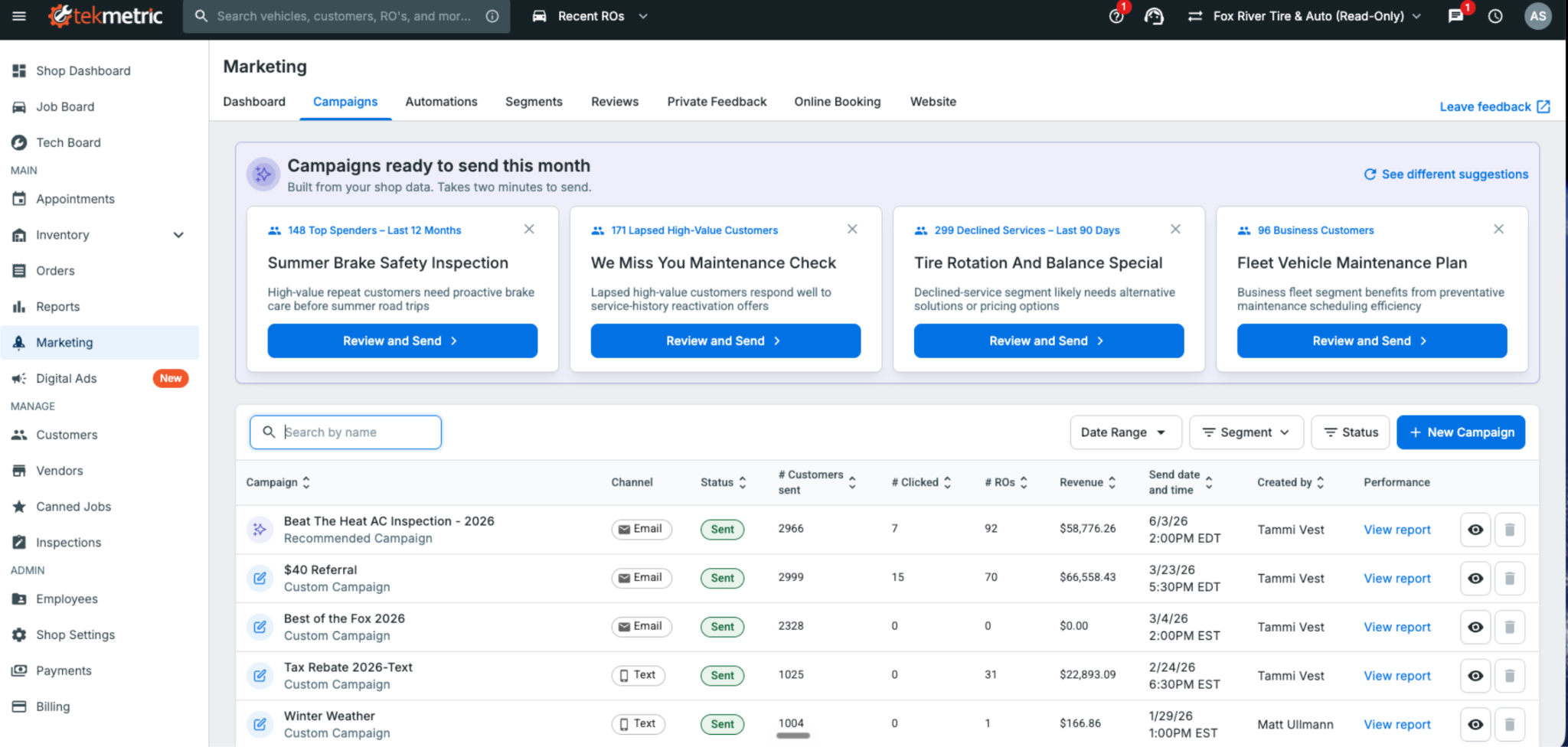
Tekmetric Marketing now builds ready-to-send campaigns. The message is written and the audience is selected. All that's left is to review, personalize, and send.
Most shop owners know the fastest way to fill this week’s bays is by bringing back customers who already trust them — the ones whose vehicles you serviced months ago but haven’t seen since. Re-engaging existing customers is one of the most effective ways to generate new repair orders.
The problem is finding the time to do it. Figuring out what to send, who to send it to, and when to send it almost always loses out to the car on the lift or the customer standing at the front counter
That's where Tekmetric Marketing's Recommended Campaigns come in.
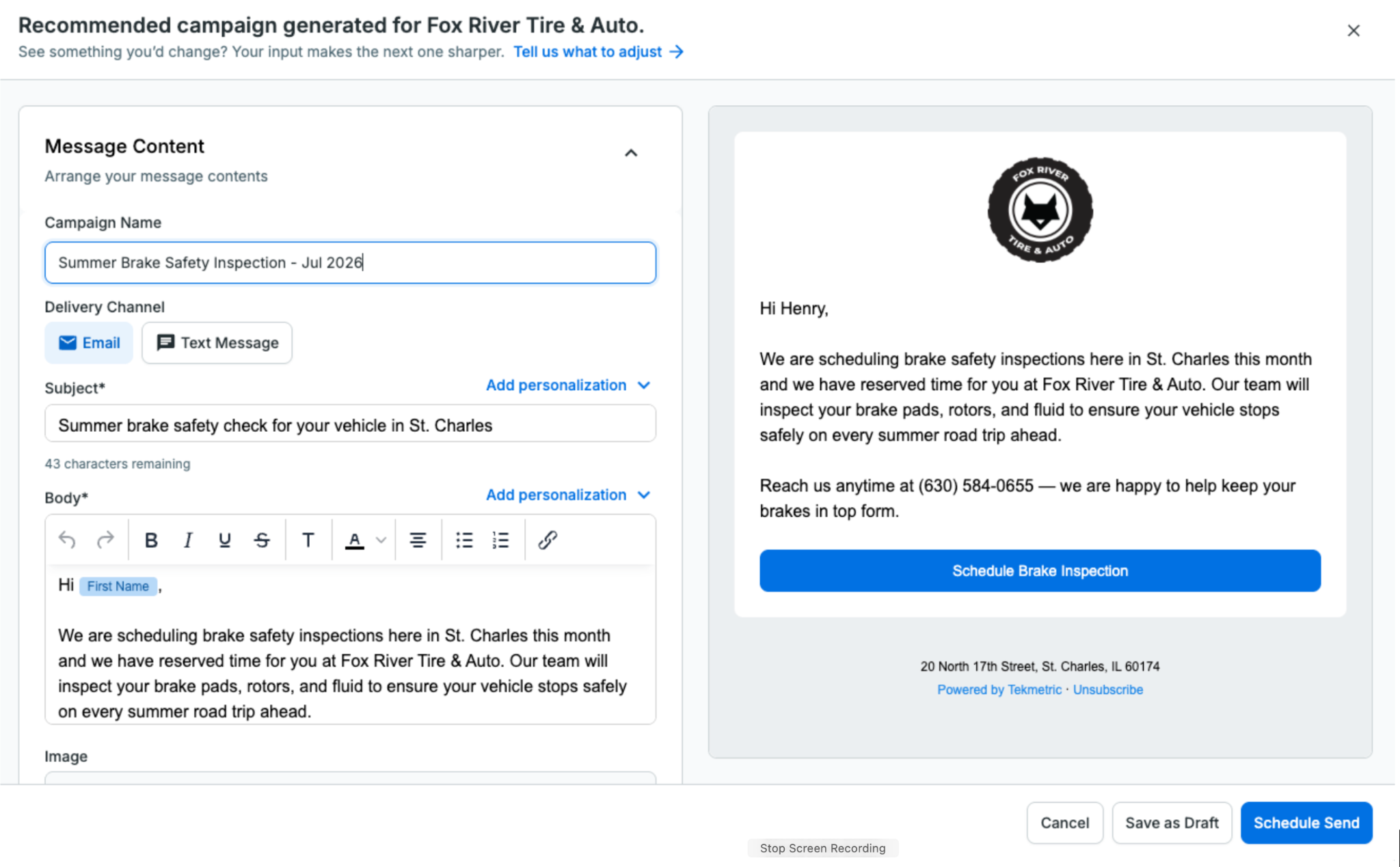
Instead of starting with a blank page, Tekmetric Marketing does the heavy lifting for you. It analyzes your shop’s data and recommends campaigns that are ready to go. The audience is selected, the message is drafted, and all that’s left is for you to review it, make any changes you’d like, and send.
No blank screen. No guesswork.
Just a campaign ready to help bring customers back.
How It Works
Recommended Campaigns automatically surfaces ready-to-send campaigns tailored to your shop using the information Tekmetric already knows — your customers, previous campaigns, location, and seasonality.
You’re always in control.
Review the recommendation, personalize the message so it sounds like your shop, adjust the audience if you’d like, choose when to send it, and you’re done.
What used to take an hour staring at a blank screen can now be done in just a few clicks.
How Fox River Tire & Auto Uses Recommended Campaigns
Like most shops, Fox River Tire & Auto in St. Charles, Illinois, wants to stay connected with customers and bring them back when the time is right. But deciding what campaign to send, then building it from scratch, takes time most shops don't have.
Recommended Campaigns gives Tammi and her team a starting point instead of a blank page. They review the recommendations, edit the suggested content to fit their brand, and send with confidence.
"Recommended Campaigns provide an excellent launchpad for re-engaging with our customers. Instead of starting from scratch, we refine the suggested content to fit our brand and send it with confidence. The process is straightforward, time-saving, and always delivers."
— Tammi Vest, Business Manager, Fox River Tire & Auto
From Reports to Results
Recommended Campaigns is part of a much bigger shift in where Tekmetric Marketing is headed.
For years, marketing platforms have been good at showing you what already happened: campaign reports, open rates, clicks, and dashboards. That’s valuable, but it still leaves the work on you.
Tekmetric Marketing is evolving beyond reporting. Increasingly, it’s helping you decide what to do next, and doing more of the work for you.
You’ve already seen this with Recommended Review Responses. When a customer leaves a Google review, Tekmetric drafts a thoughtful response for you to review and approve.
Recommended Campaigns is the next step.
Instead of simply telling you that you should market to your customers more often, Tekmetric Marketing puts a campaign directly in front of you — already drafted, targeted, and ready to send.
Your marketing should keep working even while you’re heads-down under a hood.
One Year of Continuous Innovation
Since launching Tekmetric Marketing in the fall of 2025, thousands of shops have made it part of how they attract new customers and bring existing ones back.
We’ve also continued investing in the platform based on feedback from shops like yours.
Recent additions include:
Rich text and custom links in every email so you can create more engaging emails and link directly to booking pages, review sites, and promotions. Bold a headline, organize services into a list, and drop in links to your booking page, review site, or a promotion, in both campaigns and automated emails like review requests and service reminders.
Recurring blocks for your calendar for lunch breaks, holidays, staff meetings, and other recurring events. Easily add recurring lunch blocks, staff meetings or holidays to your calendar with a few clicks. No more appointments booked over your team events without you knowing.
Smarter marketing-source tracking on appointments and ROs: Automatically associate appointments and repair orders with the latest marketing campaign or automation that reached the customer. When a customer books after getting a message, the marketing source pre-fills with the most recent campaign or automation sent to them, so attribution is accurate without the guesswork.
Recommended Review Responses, helping you respond to Google reviews in just a few clicks.
Every one of these improvements started with feedback from shop owners looking for simpler, smarter ways to grow their business.
Keep it coming.
Already using Tekmetric Marketing?
Head to Marketing → Campaigns to see what's recommended for your shop and send your first campaign in just a few clicks.
New to Tekmetric Marketing?
See how Tekmetric Marketing helps shops bring customers back with online booking, automated reminders, review generation, and Recommended Campaigns.




.svg)



.svg)

.svg)
.svg)
.svg)
.svg)
.svg)
.svg)