The Best Software for Auto Repair Shop Owners Who Want Grow Their Business

|

January 20, 2023

|

Read time: 3 min

When you started your auto repair business, you probably had to make some big investments, including property, equipment, and employees. Now, to take your shop even further, you might be considering investing in a shop management system.

A shop management system can quickly transform your shop. An ideal system helps you create more efficient workflows and keep track of critical metrics so you can make savvier business decisions.

However, the idea of transformation can cause some doubts. You might be worried that your team might not even like using the shop management system, that adjusting to change will take too long, and that the software ultimately won’t end up paying for itself.

To eliminate doubts, it’s important to find the shop management system that will:

  • Transform your shop with little hassle, as quickly as possible
  • Inspire your team to work more efficiently
  • Grow your business’ profitability so that the investment is more than worthwhile
  • Free up your time

So, what’s the best software for auto repair shop owners? And what features should you look for? Here’s what you should be considering as a shop owner.

Cloud-Based

There’s a reason more and more people are switching to cloud-based software: it’s hassle-free. To transform your shop, you won’t have to go through an extensive, complicated installation process that involves purchasing and setting up servers. You also won’t have to worry about losing your data if those servers malfunction.

Instead, with cloud-based software, you can just move over your data, log in to your system on your browser, and in no time, you and your team can get to work. Once you and your team have gotten the hang of it, you’re free to pretty much work from anywhere you have an internet connection.

With Tekmetric, your shop’s data lives on the cloud. After all, there are days when you won’t be able to make it to the shop. Maybe your child is sick and you need to take them to the doctor, or maybe you need to head out of town for a conference. But, in either case, you still want to know what’s going on at your shop. Here’s how Tekmetric user Matthew Carlson of Fix It Forward Auto Care puts it:

​​”The thing that really impressed us right away with Tekmetric was the ease-of-use—the ability for anybody in the shop to see what's going on and be able to use it. Because it's cloud-based, everyone in my shop has a computer, and they know what’s going on.”

Customer Support

Change is challenging, especially when it comes to switching to a new shop management system. A cloud-based solution simplifies the transformation process from the get-go, but a reliable customer support team will help you get your data transferred over within the first few weeks. They’ll also help you and your employees quickly learn everything you need to know to overcome initial challenges and maximize the software.

The reality is that no software is hiccup-free, especially when you’re learning to navigate it as a new user—you’ll want to learn all the tips and tricks that will make your life a breeze.

Tekmetric’s reliable customer support team will be on hand to answer any questions that pop up along the way. Down the line, even as an established, experienced user, you might have a question or two about, say, a newly released feature. When you have these types of questions, you’ll want to reach customer support as soon as possible. At Tekmetric, we resolve our users’ issues rapidly, so they can keep moving their daily operations forward.

No matter which solution you’re considering, here are some questions to ask to determine how reliable their customer support is:

  • What is your process for getting my data moved over?
  • What are the best ways to reach your customer support team?
  • What are your customer support hours?
  • How many people are on your customer support team?
  • How long does it take on average to resolve support tickets?

Integrations  

When you’re onboarding to a new shop management system, integrations can help you make that transformation even more seamless.

After all, chances are that you use other solutions (parts ordering, marketing platforms, etc.) to grow your business. Ideally, you want a shop management system that has a substantial number of integrations, so you can easily keep using the tools you love alongside each other.

And with integrations, you won’t have to spend valuable time hopping back and forth between a million open tabs, and you can even explore new tools!

Tekmetric integrates with over 35 industry-leading solutions in parts ordering, marketing, management and communication, including:

  • BG Products
  • PartsTech
  • WORLDPAC
  • MyShopManager
  • Kukui
  • The Back Office
  • Slack

Workflows

Think about the various workflows you already have at your shop. Perhaps service advisors are required to update guests once their repairs are 50% of the way through. To get that information, they regularly check in with the technicians. The right shop management system will transform existing workflows at your shop, making it easier for your team to work in harmony.

With Tekmetric, you can boost your team’s efficiency. Tekmetric helps your team achieve a work more efficiently by decreasing their distractions, offering them a sense of control, and helping them set clear goals.

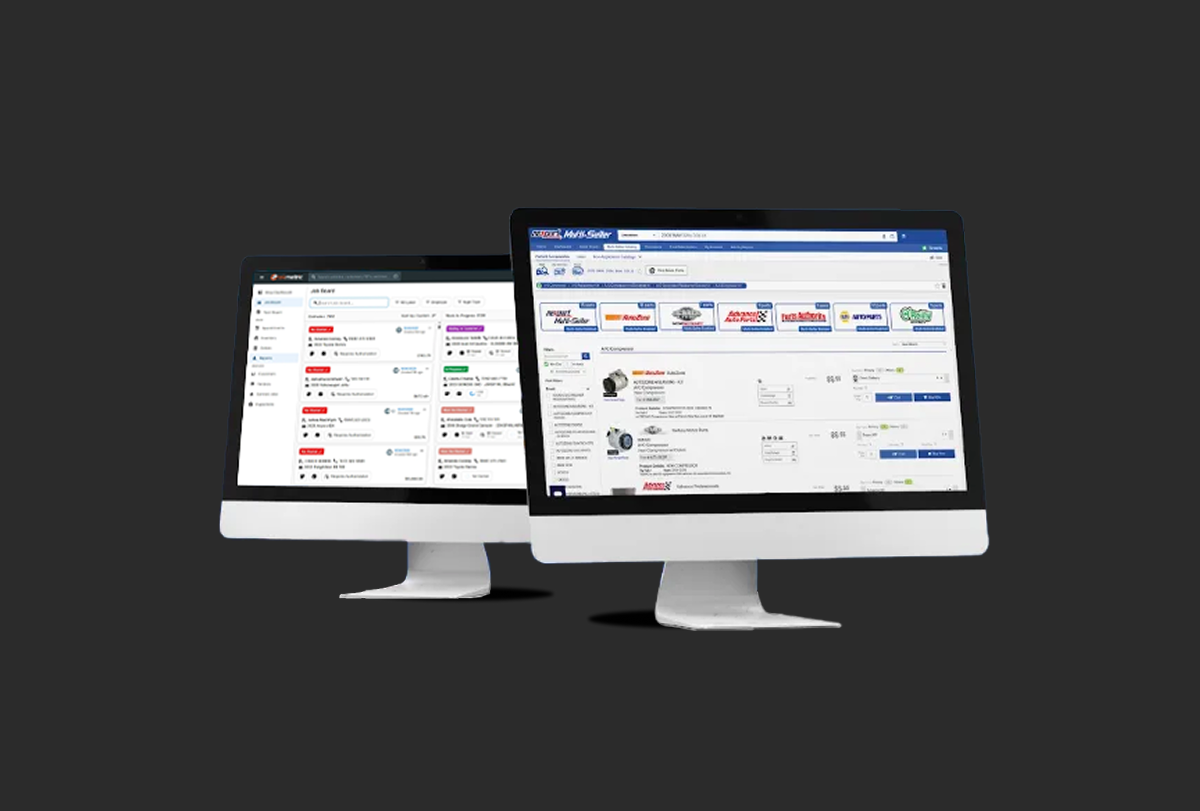
For example, Tekmetric’s Job Board gives service advisors a bird’s eye view of which stage every repair is in at your shop, including how much time is remaining. Service advisors can instantly get that information without leaving their workstations.

When you streamline workflows with Tekmetric, your team members will be able to manage themselves better. In turn, you’ll be able to focus less on managing the day-to-day operations of your shop, and more on the high-level decisions that will help you bring in more revenue, hire more team members, and perhaps even open more locations.

Reporting

One of the keys to growing your auto repair business is keeping track of various metrics, including average repair orders, car count, profit margins, labor hours, and mechanic labor efficiency.

Ideally, you want a shop management system that can generate in-depth reports and help you analyze your shop’s data, so you can make business adjustments as necessary.

For example, after reading through an End-of-Day Report, you might realize that your shop’s profit margins aren’t as wide as you’d like them to be. You can do several things to turn that around, such as ramping up your shop’s marketing efforts or slightly increasing the pricing on certain parts.

Tekmetric offers over 15 types of reporting so you can keep a pulse on your business in real time. Those reports include end-of-day reports, tech hours, declined jobs, parts purchased reports, and more.

Scalability

As you’re making decisions to grow your business, you might want to hire more employees or open another location. The last thing you want to worry about is the added cost of adding a new user or building an entirely new management system each time you open a new location.

When you’re ready to scale, it should be easy and affordable to add users or implement your shop management system at a new shop.

Tekmetric enables you to add unlimited users and devices within a single shop. And opening a new shop on Tekmetric is as simple as adding it to the system!

The Best Software For Auto Repair Shop Owners Eases Transformation, Boosts Efficiency, and Grows Your Business

Ultimately, the best software for auto repair shop owners is one that will help them transform and grow their shops with ease. To summarize, here’s how the core features we discussed help you accomplish shop transformation and growth:

Of course, you’ll want to consider other features too, such as true two-way-texting that enhance your guest experience, and touchless payment features that will enable your guests to pay whenever and wherever it’s most convenient for them.

When you start with these core features, you’ll be able to transform your shop, scale, and look at your numbers regularly and go, “Wow, this change was worth it!”

👉 Ready to grow your automotive business? [Book a personalized Tekmetric Demo Here]

FAQ

similar articles

Find out what shops in your state are charging, and how to set a labor rate that keeps your shop profitable

In the automotive repair industry, your labor rate is more than just a number on an invoice — it is one of the key metrics that drives your business's profitability and overall growth. For shop owners, staying competitive while maintaining healthy margins requires a clear understanding of how labor costs fluctuate across the country. But knowing the national average is only half the picture. The more important question is: how does your shop compare?

Whether you are running a small independent shop or a high-volume operation, knowing where you stand relative to the average labor rate in your state — and against top-performing shops in your market — is essential.

This guide covers the current landscape of automotive repair labor rates across all 50 states, the factors that drive those numbers, and a step-by-step roadmap for setting a rate that supports your shop's long-term success.

Methodology and Key Terms

Tekmetric built this auto repair shop index as a community resource, backed by data from more than 10,000 shops across North America. Shops can use this tool to benchmark themselves and see how they compare state by state.

Key Terms to Know

Labor rate: The retail price per hour charged to the customer for repair services.

Flat-rate: A pricing model where a job is billed based on a predetermined number of hours from a labor guide, regardless of how long the actual repair takes.

Effective labor rate (ELR): The actual amount of labor revenue earned per billed hour after accounting for discounts, menu pricing, and unbilled time.

Understanding these terms will help you interpret the data below and apply it to your specific situation.

Mechanic Labor Rates by State

The average labor rate across the United States is $132 per hour, with the lowest state at $85 per hour and the highest at $197 per hour. Labor rates vary significantly by state, primarily driven by local cost of living and competition.

📊 See How Your Shop Compares — Free

The data below tells you what shops in your state are charging. But the labor rate is only one piece of the picture. The Tekmetric Shop Index lets you benchmark your shop across the four metrics that actually drive profitability — ARO, car count, parts margin, and effective labor rate — against thousands of real shops nationwide.

It's free, takes less than two minutes, and requires no Tekmetric account.

➡ Benchmark Your Shop Now →

Labor Rates by State

  • Alabama: $123 per hour
  • Alaska: $151 per hour
  • Arizona: $147 per hour
  • Arkansas: $144 per hour
  • California: $163 per hour
  • Colorado: $150 per hour
  • Connecticut: $174 per hour
  • Delaware: $142 per hour
  • Florida: $154 per hour
  • Georgia: $135 per hour
  • Hawaii: $139 per hour
  • Idaho: $133 per hour
  • Illinois: $132 per hour
  • Indiana: $121 per hour
  • Iowa: $123 per hour
  • Kansas: $117 per hour
  • Kentucky: $121 per hour
  • Louisiana: $136 per hour
  • Maine: $113 per hour
  • Maryland: $138 per hour
  • Massachusetts: $130 per hour
  • Michigan: $125 per hour
  • Minnesota: $133 per hour
  • Mississippi: $113 per hour
  • Missouri: $117 per hour
  • Montana: $136 per hour
  • Nebraska: $125 per hour
  • Nevada: $144 per hour
  • New Hampshire: $125 per hour
  • New Jersey: $141 per hour
  • New Mexico: $140 per hour
  • New York: $121 per hour
  • North Carolina: $118 per hour
  • North Dakota: $129 per hour
  • Ohio: $125 per hour
  • Oklahoma: $129 per hour
  • Oregon: $147 per hour
  • Pennsylvania: $114 per hour
  • Rhode Island: $133 per hour
  • South Carolina: $126 per hour
  • South Dakota: $118 per hour
  • Tennessee: $125 per hour
  • Texas: $197 per hour — most expensive state
  • Utah: $137 per hour
  • Vermont: $102 per hour
  • Virginia: $133 per hour
  • Washington: $148 per hour
  • West Virginia: $85 per hour — lowest in the nation
  • Wisconsin: $121 per hour
  • Wyoming: $134 per hour

Factors That Impact Automotive Labor Rates

Why do auto repair labor rates vary so widely from state to state? A few key factors drive the differences.

Cost of Living

In states with a higher cost of living, shop owners face higher wages to attract technicians, more expensive rent, and elevated utility and supply costs. Those overhead realities push labor rates up — not because shops are padding their margins, but because the math demands it.

Shop Type and Specialization

Dealerships typically carry the highest labor rates because of their overhead, factory-trained technicians, and reliance on OEM parts. Independent shops often have more pricing flexibility, particularly for routine services like oil changes. Specialty shops — focused on European vehicles, diesel, or performance — tend to command higher rates as well.

➡ Benchmark Your Shop Now →

Technician Expertise and Certifications

A diagnostic job requires a different skill set than a brake job. Shops that employ ASE-certified technicians or master technicians can and should charge accordingly. The rate reflects the expertise required to do the work correctly.

How to Set Your Labor Rate (Step by Step)

Setting your rate shouldn't be based on what the shop down the street is charging. It should be a data-driven decision grounded in your actual costs and performance targets.

Step 1: Calculate Your "Loaded" Labor Cost

Start with what it actually costs you to have a technician on the floor. This includes:

  • Wages and overtime
  • Payroll taxes
  • Benefits (health insurance, 401k)
  • Workers' comp and liability insurance
  • Training and certifications

Divide that total annual cost by the number of billable hours that technician produces in a year. That's your loaded cost — and it doesn't include any profit margin yet.

Step 2: Account for Overhead

Your labor revenue also needs to cover the cost of running the business:

  • Rent
  • Utilities and shop supplies
  • Marketing and software
  • Taxes

Step 3: Determine Your Target Profit Margin

Tekmetric shops average 65% labor profit margins. If your loaded cost for a technician is $45 per hour and you want a 65% margin, your base labor rate should be at least $128 per hour.

Step 4: Benchmark Against Your Market

Your internal numbers come first, but you can't ignore the local market. If your rate is $128 and every comparable independent in your area is at $100, you need to either clearly justify your value — through better inspections, faster turnaround, stronger communication — or find ways to reduce overhead. Benchmark against shops of similar size, service mix, and geography.

Step 5: Implement a Labor Matrix

Not every repair order is equal. Shops that implement a labor matrix can automatically adjust rates based on job complexity — billing more appropriately for diagnostic work or specialty repairs without manually recalculating every estimate.

➡ Benchmark Your Shop Now →

How Tekmetric Helps Your Shop Stay Profitable

Managing labor rates manually is a recipe for inconsistency and missed revenue. Here's how Tekmetric gives you the tools and data to stay ahead.

Know Where You Stand with the Tekmetric Shop Index

Before you can optimize your labor rate, you need to know how your performance compares to other shops. The Tekmetric Shop Index gives you free, instant benchmarking across four metrics: ARO, car count, parts margin, and effective labor rate. Enter your shop's numbers and see exactly where you rank against thousands of shops nationwide — no account required, no sales call, no commitment.

You can't improve what you don't measure. This is where that work starts.

➡ Benchmark Your Shop Now →

Real-Time Profitability Tracking

Tekmetric's reporting features give you live visibility into ARO, car count, revenue, and technician productivity — so you always know how your shop is performing, not just at the end of the month.

Custom Labor and Parts Matrices

Tekmetric lets you build a labor matrix that automatically adjusts rates by job type. A custom parts matrix works the same way on the parts side, protecting your margins consistently across every repair order.

Digital Inspections That Justify Your Rate

Tekmetric's digital vehicle inspections let your team send photos and videos of needed repairs directly to a customer's phone. When a customer can see the worn brake pad or the leaking gasket for themselves, they're far more likely to approve the work — and far more comfortable with the rate attached to it.

Accurate Labor Guide Integration

Tekmetric integrates with industry-standard labor guides so your estimates are based on real, accurate times — not guesswork or memory. That means technicians get credited fairly under a flat-rate system, and your service advisers spend less time on paperwork and more time with customers.

Benchmark Your Insights Now

Knowing the average labor rate in your state gives you a useful reference point. But the shops that stay profitable long-term don't stop at state averages — they benchmark continuously, track the right metrics, and make adjustments based on data instead of instinct.

Your labor rate should reflect your actual overhead, your team's capabilities, and the quality of service your customers experience. Use the state data above as a starting point, then go deeper with the Tekmetric Shop Index to see how your shop compares across every metric that drives profitability.

Ready to see where you stand? Benchmark your shop free with the Tekmetric Shop Index →

Average Auto Repair Labor Rates by U.S. State

June 30, 2026

Read time: 3 min

read more

Compare your shop's performance against real data from thousands of auto repair shops by state.

Benchmarking data is only useful when it changes what you do next.

If you've run your shop's numbers through the Tekmetric Shop Index and seen where you rank on ARO, car count, parts margin, and effective labor rate — good. You have a diagnosis. Now you need a plan.

This post walks through what each gap in your TSI results is actually signaling, which operational levers move the needle on each one, and how to build a focused 90-day improvement target that gives your team something concrete to work toward.

Start With the Biggest Gap

Your TSI results will show you four rankings. Resist the temptation to try to improve all four at once. The shops that make the most progress pick the metric with the largest gap and stay focused on it for a full quarter before adding another priority.

Trying to improve ARO, car count, parts margin, and effective labor rate simultaneously often means improving none of them because the operational changes required for each are different and can compete for your team's attention.

So step one is simple: look at your four rankings, find the biggest gap from the industry benchmark, and start there.

Gap: ARO Below Benchmark

If your average repair order is lagging, the most common root cause is inspection performance. Either digital vehicle inspections (DVIs) aren't being completed consistently, or they're being completed but not converted into approved work.

A few questions to answer before you act:

  • What percentage of repair orders have a completed DVI attached?
  • Of the DVIs sent to customers, what percentage include photos or video?
  • What's your close ratio on recommended work?

If DVI completion is below 90%, that's almost always the first lever. Tekmetric's Inspection Report shows completion rates by technician, making it straightforward to identify who needs coaching and who's already performing well.

"Now I can look at everybody at a glance. I can be in a different state, different city and know exactly what's going on in each location all the time."  — Leroy Ingram, Ooroo Auto Care, Tekmetric Customer

If DVI completion is strong but close ratio is low, the issue is likely in how inspections are being communicated to customers — photo and video quality, the language in findings, how quickly the estimate follows the inspection.

Shops on Tekmetric also have access to the Parts and Labor Matrix, which protects against underpricing. It can be a quiet ARO killer that doesn't show up until you look at margin data.

➡ See how your ARO compares →

Gap: Car Count Below Benchmark

A car count gap can mean two different things depending on how it breaks down: you're not bringing in enough new customers, or your existing customers aren't returning at the rate they should. Both problems need attention, but they need different solutions.

For new customers, the questions are acquisition-focused. Tekmetric's online booking gives customers a way to find you and schedule an appointment 24/7 — filling bays without your team picking up the phone. The more friction you remove from the booking process, the more new customers follow through.

For returning customers, the questions shift to communication. Are declined jobs being followed up? Are customers receiving service reminders? Tekmetric Marketing automates follow-ups on declined work and scheduled maintenance intervals — so your team stays in contact with your car count without adding manual effort.

"Seven hundred and two dollars in ad spend has generated 11 net-new customers and $12,802 in new customer revenue — an 18.3x return on ad spend before factoring in the lifetime value of those customers returning for future visits."  — Tanner Markham, Phase 2 Automotive, Tekmetric Customer

➡ See how your car count compares →

Gap: Parts Margin Below Benchmark


A parts margin gap is almost always a pricing problem — either your markup isn't keeping up with cost increases, you're applying flat markup where a tiered matrix would protect margin better, or your team is manually overriding prices inconsistently.

The fix starts with reviewing your Parts Matrix in Tekmetric. A well-structured matrix automatically applies the right markup based on part cost ranges, removing the inconsistency that comes from individual pricing decisions at the job level.

After updating the matrix, run your Parts Purchased Report to verify that retail pricing is reflecting the changes accurately. This is also a good time to cross-reference against recent vendor invoices — if costs have moved significantly in the last 6 months, your matrix thresholds may need updating.

➡ See how your parts margin compares →

Gap: Effective Labor Rate Below Benchmark


If your effective labor rate is trailing your posted rate, the most common culprits are inconsistent discounting, flat-rate job structures that cap labor recovery, or package pricing that doesn't account for actual labor time.

Start by pulling your Discount Detail Report to see where and how often discounts are being applied. If they're being applied inconsistently across your team, that's a coaching conversation — and Tekmetric's real-time reporting makes it easy to see which service writers are discounting most frequently.

The Labor Matrix is the structural fix. Similar to the parts matrix, a tiered labor matrix adjusts the billed hours or dollar amount based on configured ranges, protecting margin without changing what customers see on the invoice.

➡ See how your effective labor rate compares →

Building a 90-Day Improvement Target

Once you've identified your primary gap and the lever that addresses it, the last step is turning it into a measurable target for the next 90 days.

A good 90-day target is specific, tied to a leading indicator, and gives your team something to track week over week. For example:

  • ARO gap: "Increase DVI completion rate from 72% to 90% over 90 days, tracked weekly via Inspection Report"
  • Car count gap: "Launch declined-job follow-up automation within 30 days; track returning car count monthly for 90 days"
  • Parts margin gap: "Update Parts Matrix for all parts under $150 within two weeks; track parts margin weekly via Parts Purchased Report"
  • Labor rate gap: "Reduce average discount percentage by 15% over 90 days, tracked via Discount Detail Report"

These aren't arbitrary numbers — they're examples of the leading-indicator approach that lets you see progress before the outcome metric moves. Set yours based on where you're actually starting, not where you want to end.

Check Your Rankings Quarterly

Your TSI results are a snapshot. Set a reminder to re-run the benchmarking every quarter so you can see whether your numbers are moving relative to the industry — not just relative to your own history.

The shops that use benchmarking most effectively are the ones that treat it as a recurring discipline, not a one-time exercise.

"Thanks to Tekmetric, we've really enhanced our business and are looking to expand. We're the #1 shop, 6 years in a row in Upstate New York."  — Chris Chevalier, AAA Auto Repair, Tekmetric Customer

➡ Benchmark your shop now →

Takeaways

  • Start with your biggest gap — don't try to move all four metrics at once.
  • ARO gaps usually trace back to DVI completion rates or close ratios.
  • Car count gaps split into acquisition and retention problems — each needs a different fix.
  • Parts margin gaps are almost always a pricing matrix issue.
  • Effective labor rate gaps often come down to discounting habits and job structure.
  • A 90-day leading-indicator target turns benchmarking data into team direction.

➡ Benchmark your shop now →

See how your shop stacks up against thousands of auto repair shops nationwide

You track your ARO. Maybe you watch your car count week over week. You know when a month is good and when it's below par.

But here's a question most shop owners can't answer quickly: Compared to shops like yours, are your numbers strong, average, or quietly underperforming?

There's a real difference between a number that's improving and a number that's competitive. A shop can grow ARO year over year and still be well below what high-performing shops are seeing in their market. Without an external reference point, you don't know which situation you're in.

That's the problem benchmarking solves, and it's the reason the data matters more than the direction.

Internal Tracking Tells You the Trend. Benchmarking Tells You the Truth.

Internal performance tracking is essential. If you don't know your ARO, car count, parts margin, and effective labor rate, you're managing without the most basic tools. But internal tracking has a structural limitation: it can only tell you how you're doing relative to your own history.

That's useful for spotting momentum — a rising ARO, a growing car count, tighter parts margin. What it can't tell you is whether your baseline is strong or weak relative to the market.

A shop with a $580 ARO that has grown from $520 over two years has made real progress. But if top-performing shops in their region are averaging significantly higher, that progress hasn't closed the competitive gap. It's just moved in the right direction.

The fix isn't to stop internal tracking. It's to add an external benchmark so you know what the target actually looks like.

➡ See how your ARO compares →

The Problem With Benchmarking From Anecdotes

Many shop owners get their benchmarks the informal way: conversations with peers at trade shows, numbers shared in coaching groups, or revenue figures posted in forums. These have real value, but they're also limited.

Self-reported numbers skew high (people share their wins). Peer groups are small samples. Industry averages from trade associations are often lagged and lack the granularity you need to compare fairly — a six-bay shop in a suburban market shouldn't be benchmarking against national averages that include dealership-adjacent shops in metro areas.

The more useful comparison is data drawn from shops operating in similar conditions, at similar scale, tracked in a consistent and anonymized way.

What Good Benchmarking Actually Looks Like

Effective benchmarking for an auto repair shop compares you on the four metrics that most directly drive profitability:

  • ARO: Are you getting full value from each car that comes through your door?
  • Car count: Is your volume where it needs to be to support your revenue goals?
  • Parts margin: Are you protecting margin as supplier costs fluctuate?
  • Effective labor rate: Is your real revenue per labor hour aligned with your posted rate?

Each of these metrics has a different lever. If your ARO is lagging, the fix usually involves inspection completion rates or customer communication. If your car count is stagnant, the issue is typically acquisition or retention. If your parts margin is eroding, your pricing matrix needs a look. If your effective labor rate is low, it's often a discounting or packaging problem.

Benchmarking tells you which problem to solve first. That's valuable when you have limited time and you're trying to prioritize.

How the Tekmetric Shop Index Works

The Tekmetric Shop Index is a free benchmarking tool built from data collected across more than 12,000 auto repair shops. Enter your shop's metrics and get an instant comparison showing where you stand on each of the four key measures. No Tekmetric account is required. Anyone can use it.

The output isn't a vague grade — it shows you where each metric ranks and gives you a clear picture of where the gap is largest. That's the signal that tells you where to focus first.

➡ Benchmark your shop now →

What to Do After You See Your Rankings

The benchmarking data is the starting point, not the finish line. Once you know which metric is your biggest gap, you can start asking the right questions:

  • If ARO is lagging: How consistently are your technicians completing and sending digital vehicle inspections (DVIs)? Are customers seeing and approving the recommended work?
  • If car count is flat: Are you actively pursuing new customers? Are return visit intervals optimized? Are declined jobs being followed up?
  • If parts margin is soft: When did you last review your parts pricing matrix? Is it adjusting for recent cost increases from your vendors?
  • If the effective labor rate is low: Are service writers building jobs accurately? Are discounts being applied consistently or inconsistently?

Each of these questions points toward a workflow, and Tekmetric's reporting is built to surface the answers at the job, technician, and service writer level. But even before you get to that step, knowing which question to ask is most of the work.

➡ Benchmark your shop now →

The Shops Getting This Right

High-performing shops don't treat benchmarking as a one-time exercise. They check their rankings periodically, track how their numbers shift against the industry baseline, and use the comparison to coach their teams with context.

"You're at 85% DVI completion" is a data point. "You're at 85% completion, and top shops are at 95%" is a coaching conversation with direction.

"Seeing them take the shift to Tekmetric and then grow profitability in the same four walls has been phenomenal. Some of them are just exponential."  — Matt Schwab, Clutch Automotive, Tekmetric Customer

Takeaways

  • Internal tracking shows you direction; benchmarking shows you position.
  • The four metrics — ARO, car count, parts margin, effective labor rate — are the right comparison points.
  • Good benchmarking data is consistent, anonymized, and drawn from shops with similar operating profiles.
  • The TSI tool is free, built from more than 12,000 shops, and gives you an instant read on where your gaps are largest.
  • Your benchmark result tells you which lever to pull first — and that's where the work starts.

Once you know your gaps, the next step is building a system to close them.

➡ Benchmark your shop now →