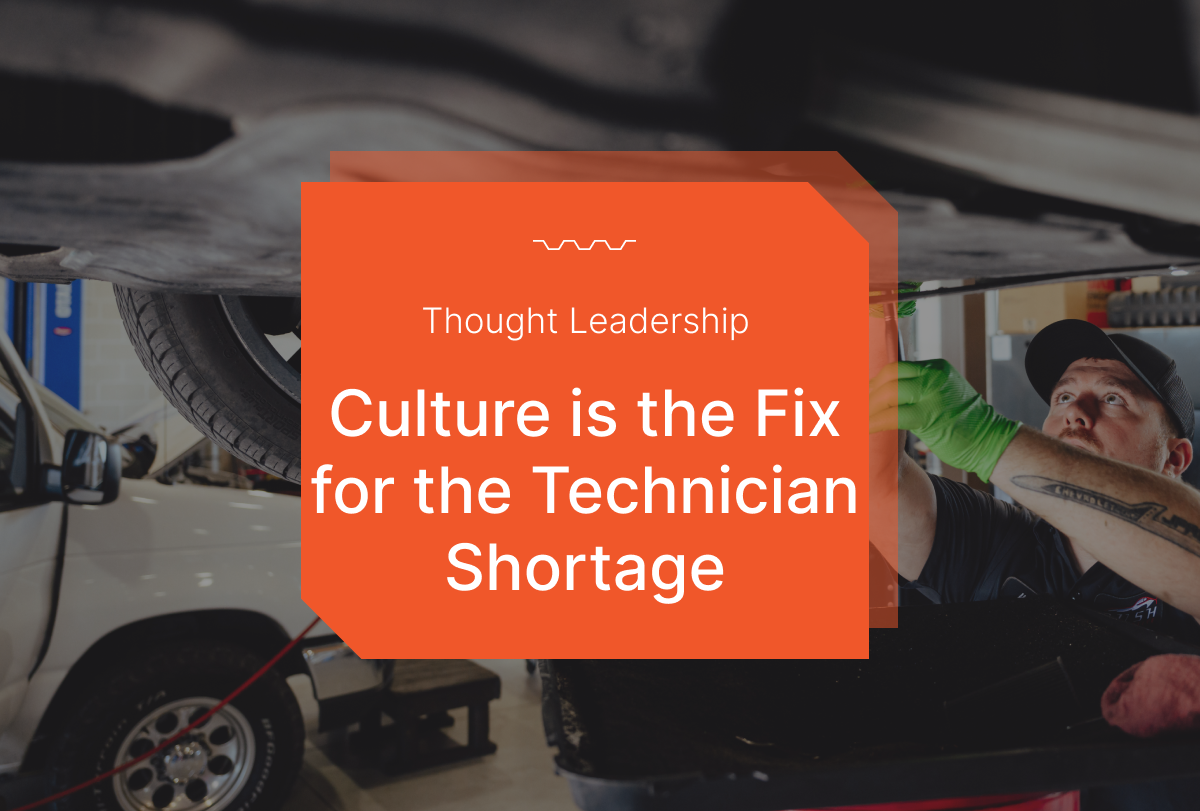

Creating a great culture at an auto repair shop is the key to keeping and growing technicians
Cars are lasting longer than ever, but the technicians who fix them are becoming harder to find. The average vehicle on U.S. roads is about 13 years old, and there are not enough skilled technicians to go around.
The auto repair sector needs about 71,000 new technicians a year, and the training pipeline delivers only about 50,000. That is more than 20,000 unfilled positions every year, and the shortfall continues to grow.
That gap is stark.
For auto repair shops, the shortage is not a statistic. It is a daily question: who is going to fix the cars?
Sunil Patel, Tekmetric founder and CEO, said this crisis can be solved with auto repair shop improvements. Those solutions, however, often are not the ones most shop owners typically expect.
Before he founded Tekmetric, Patel owned Motorwerks, an independent repair shop in Houston, Texas, where he learned about the technician shortage from inside the bay. After years of seeing the problem as a shop owner and now as an automotive repair technology leader, Patel says the shortage will not be solved with better software alone.
It starts with creating a great culture and valuing people. Patel speaks from firsthand experience, and his conviction on where to start is clear.
"I would spend a lot more time on the culture side of it," he said. "I would make sure I'm building an amazing culture that attracts amazing technicians."
The First Hire
Patel started Motorwerks as a one-man operation. He turned wrenches at night and took vehicles in during the day. There was no hiring strategy because there was no one to hire but himself.
Then the work outgrew him.
"Eventually I started getting busier and busier, and I needed a technician," Patel said.
He reached out to a contact at a local dealership and asked if he knew anyone looking for work. The technician that was recommended had just been let go from the dealership. He had made a mistake, but he was genuinely skilled. Patel took the chance and hired him.
It paid off.
"He would crank out hours, and he was really good at his job," Patel recalled.
The technician struggled with diagnostics, but that happened to be the part Patel enjoyed most. The two skillsets fit together. The shop kept moving.
That early hire taught Patel something he tells shop owners to this day: a great technician is rarely great at everything, and the shops that win are the ones that build a team around complementary strengths and skills.
Why Hiring Became Harder
The work itself is part of the challenge. Repairing cars has always been demanding, but it keeps getting harder, and nowhere more than at an auto repair shop.
Consider the difference between a dealership and a shop. A dealership technician works on a narrow set of vehicles from a single manufacturer, where the engineering stays largely consistent from one model to the next.
"If I take the most compact car versus the most expensive car, the underlying technology is going to be very similar at a dealership," Patel explained.
A technician who has never touched a particular model can usually still work on it because the platform underneath is familiar.
An independent auto repair shop has no such predictability. It can take all makes and all models.
"You don't know what's going to come through that door," Patel said.
Shops can see a Honda one morning, a Toyota that afternoon, and a European luxury car the next day. Every job can push a technician past what they know best. And the steepest part of that climb is no longer mechanical — it is electronic.
"The hard part of this is not the mechanical side," Patel said. "It's the electronic side where technicians usually get stuck."
Modern vehicles run on layered software, networked sensors, and advanced driver-assistance systems. The U.S. Bureau of Labor Statistics notes that technicians increasingly work on these complex electronic and computerized systems, and diagnosing them well is a specialized skill. Those specialized skills are exactly what the labor market is short on.
No shop can send its team to factory training for every brand. There are more than 50 vehicle manufacturers on the market. The best shops specialize the way Patel did at Motorwerks: for instance, one technician strong on European vehicles, another on Japanese, another on domestic. That mix lets a shop triage almost anything that rolls in, and it turns a hiring problem into a team-building one.
The Myths Keeping Young People Out
Ask most people to picture a technician, and the image is dated. Greasy hands. A hot bay. Hard, dirty work.
Patel said that picture is a mischaracterization of how technicians work today.
"A lot of that is changing," he said.
Some independent shops today are fully air-conditioned. Part of the work is no longer mechanical — it is electronic, diagnostic, coding, and programming.
"You've got to be able to use a laptop," Patel said.
The old image does real damage. It steers young people away from a career that has quietly modernized. Correcting it, in Patel's view, is one of the industry's most important recruiting jobs.
Culture Is the Real Reason Technicians Leave
Patel said one pattern separates the businesses that attract and keep great technicians from the ones that cannot. It is culture. And many shops have room for improvement.
"When a technician leaves a repair shop, it's not because of the money," Patel said. "It's mainly because of the culture and environment, or lack thereof, that causes them to leave to another shop."
There is a structural reason culture gets neglected. Many independent shops are founded by technicians.
"They're not trained in the fundamentals of running a business, attracting top talent, and building an amazing culture," Patel said.
Most learn it through trial and error.
His prescription is uncomfortable for a lot of owners. Ask your technicians how they actually feel about working for you. What do they like? What do they not like?
"These are things shop owners sometimes don't even want to ask because it's out of their comfort zone," Patel said.
But the question itself sends a message.
"I want to make sure I'm doing everything in my power to build an amazing environment for you to thrive in, to grow," Patel said. "This is an emotional thing.”
The cost of getting it wrong is measurable. Collision shops alone see 30 to 40 percent annual technician turnover, according to a 2024 industry study from I-CAR and the Society of Collision Repair Specialists. Replacing skilled workers runs an estimated one-half to two times their annual pay when recruiting, lost production, and training are totaled, per Gallup.
In a trade this short on talent, a culture that keeps people is not a soft benefit. It is a bottom-line advantage.
The Small Things Add Up
Building culture does not require a consultant or a budget line. At Motorwerks, it was lunch.
Every Friday, Patel bought the team lunch and let the technicians pick the food. Eventually, he started barbecuing in the back of the shop, then rotated the grilling duty across the crew. He also experimented with better health care and benefits.
None of it was flashy. All of it pointed the same direction.
"Making them feel like we care is what it boils down to," Patel said.
Real Pay and a Real Career Ladder
Technician compensation is misunderstood. Many people assume a shop career is a financial dead end. It is not.
"Some of the best technicians can earn a solid six figures," Patel said.
The range is wide, and that is the part young people rarely hear. The median automotive technician earns about $49,670 a year, according to the U.S. Bureau of Labor Statistics. But the ceiling is far higher. Top flat-rate and master technicians routinely clear $100,000, and the fastest specialists earn as much as $160,000. The career rewards skill and speed, and its best earners are paid like it.
But money alone does not keep a technician on the job because the work is physically taxing. Technicians spend hours in awkward positions, lifting heavy parts, and holding components in place. Cuts, bruises, and back strain add up. Long days take their toll.
That is why Patel believes shops need a ladder, not just a wage. Owners should create a pathway for young technicians to grow into team leads, roles where their experience lifts the next generation rather than only their own billable hours. A career with a visible next step keeps good people in the industry.
Where Technology Fits
Patel is candid about the role Tekmetric plays in all of this. Technology did not create the shortage, but fragmented software makes technicians' jobs harder than they need to be.
For years, the shop technology stack was disconnected: one system for the front counter and a separate one for the technicians in the bay.
"Nobody's ever created an end-to-end solution from the time a vehicle is taken into a repair shop to the time it's fixed," Patel said.
Building that single, unified platform is the problem he set out to solve.
Tekmetric built tools specifically for technicians. The Tekmetric mobile app lets technicians move faster and target the exact friction that makes technicians skip digital vehicle inspections (DVIs).
Ask a technician why they do not run a DVI on every vehicle, and the answer is speed. It takes too long to photograph the issue, edit the images, and write it up. Tekmetric collapses that into something as simple as taking a video.
The payoff shows up in the numbers shops care about. The average repair order across Tekmetric shops is $612. With DVIs active, it climbs to $741. Add MotoVisuals video, and it reaches roughly $800. Faster, easier inspections do not just help the technician. They help the customer make an informed decision, and they help the shop grow.
The technicians are now the ones pushing owners to modernize.
Patel has watched technicians go to new shops and refuse to work on anything else other than Tekmetric. The platform's ease of use is what keeps them hooked.
"They tell the new shop, 'I'm not using whatever you have. You have to switch to Tekmetric,'" he said.
Building the Next Generation
Closing the shortage means reaching young people before they ever pick a trade. Patel is betting on the classroom.
Tekmetric is leading the effort by working directly with trade schools to understand what it can do to help, and what it found was a gap. Many training programs still run on pen and paper, or carry a cost for software and repair guides that creates a financial barrier to invest in other places.
"A young person comes in who's stuck on their iPhone, and they think, 'This is how this industry operates,'" Patel said.
The disconnect between the technology in a student's pocket and the technology in the classroom is its own recruiting problem.
To combat this, Tekmetric gives its platform to these schools for free. The goal is to let the next generation see, from day one, that a modern shop runs on modern tools.
Patel's pitch to any high school guidance counselor is straightforward. A student can leave high school, work as a technician for five to 10 years, and open a shop of their own.
"That is something exciting, and it's meaningful income," he said. “It is a path to ownership, not just a job.”
Why It Matters to Him
Patel has been in this industry long enough to feel its history personally, back to the muscle cars of the 1980s.
"It's part of the fabric of America, and it's what makes this country great," he said.
He knows the pains that shop owners, service advisors, and technicians carry, because he has carried them himself.
He is hopeful the shortage reverses, and clear-eyed about what will and will not get it there. Better tools help. Better training helps. Better culture helps most.
The shortage, in the end, is a people problem. Patel's whole argument is that shops should start treating it like one.
"AI is not going to solve fixing cars," Patel said. "That's something a human being is going to have to do for a while."



.svg)



.svg)

.svg)
.svg)
.svg)
.svg)
.svg)
.svg)