We're happy to announce that our commitment to innovation and customer satisfaction has been recognized! For Spring 2025, G2 has awarded Tekmetric with a range of badges, including Momentum Leader, Best Results, Best Usability, Most Implementable, and Grid Leader.
These awards reflect our customers' experiences and trust in Tekmetric, highlighting their role in our success.
What These Badges Mean
Momentum Leader: We're leading the pack, constantly evolving to meet the ever-changing needs of the automotive industry.
Best Results & Best Usability: Tekmetric is designed to be intuitive and user-friendly, helping you achieve the results you want.
Most Implementable: Change can be scary – That's why we've made it easy to get started and integrate with Tekmetric so you can hit the ground running.
Grid Leader: This badge showcases how our customers describe Tekmetric as the go-to solution for auto shop management.
Thank You to Our Customers
We couldn't have done it without our customers! Your feedback and support drive us to continually improve and deliver the best possible shop management experience. We're excited to continue this journey with you and can't wait to see what we accomplish together in the future. We'll continue to innovate, listen to your feedback, and provide the tools you need to run your shop.
Starting a tire shop can be a profitable business venture, especially if you already own an auto repair shop and want to expand your services. Today's vehicle owners are increasingly looking for one-stop shops that cater to all their automotive needs, from engine repairs to tire services.
By adding tire services to your offerings, you can attract more customers and increase your revenue. Services typically include tire sales, installation, balancing, rotation, and repair. In this guide, we'll cover everything you need to know about how to start a tire shop, including the permits required, startup costs, profitability, and tools to help you streamline your operations.
10 Steps to Open Your Tire Shop Business
1. Market Research and Planning
Market Research: Assess the demand for tire services in your area, analyze the competition, and identify your target market.
Business Plan: Outline your business plan, target market, competition analysis, services offered, pricing strategy, and financial projections.
2. Legal Considerations and Permits
Business Structure: Decide whether to register as a sole proprietorship, partnership, LLC, or corporation.
Licenses and Permits: Obtain the necessary licenses and permits to operate a tire shop, including a business license, sales tax permit, and any environmental permits for proper tire disposal.
Insurance: Get appropriate insurance coverage, such as general liability, property, and worker's compensation.
3. Startup Costs and Financing
Startup costs for a tire shop can vary depending on factors such as location, size, and the range of services offered. If needed, secure funding through personal savings, investors, or loans. Typical expenses include:
Lease or purchase of property: Costs will vary based on location and size.
Equipment and tools: Tire changers, balancers, alignment machines, and hand tools.
Inventory: Initial stock of tires and related products.
Marketing: Advertising and promotional materials to attract customers.
Staffing: Wages for skilled technicians and support staff.
4. Choose a Location
Select a location that is easily accessible and visible to potential customers. High-traffic areas near major roads or highways can increase your shop's visibility and attract more customers. In addition, consider how close your shop will be to competitors and other auto repair shops.
5. Marketing and Branding
Branding: Develop a strong brand identity, including a logo, signage, and marketing materials.
Marketing Plan: Implement marketing strategies, such as local advertising, online marketing, and promotions. Consider offering discounts, loyalty programs, and special deals.
Website: A website may be your first impression to a potential customer. Make sure your website showcases your services and shop appropriately.
SEO: Search engine optimization (SEO) can be a powerful tool to help shops be more visible to local customers searching for auto services.
Social Media: Platforms like Facebook, Instagram, and TikTok can be useful tools to help you reach new customers and promote special offers/events.
Local Advertising: Billboards, signage, Google ads, and direct mailers can be influential local marketing tactics to win over new customers.
Tek-Tip: If you need help coming up with a tire shop business name, we have developed a guide to the best automotive business names. In addition, we developed an AI-powered mechanic business name generator tool that can also help with logo creation.
6. Equipment and Tools
Invest in high-quality equipment and tools to provide efficient and reliable tire services. Essential equipment needed to open a tire shop includes:
Suppliers: Establish relationships with tire suppliers and distributors. Negotiate favorable terms and prices.
Inventory: Stock a range of tires for different vehicles and price points. Include related products like rims, tire accessories, and repair kits. Consider stocking a diverse inventory with summer, winter, performance and off-road tires.
8. Staffing and Training
Hire experienced and skilled technicians who are knowledgeable about tire services and automotive repairs. Providing ongoing training and development opportunities can help ensure your staff stays up-to-date with industry trends and best practices.
9. Tire Shop Software
To streamline your tire services and improve efficiency, consider implementing Tekmetric's Tire Suite. This powerful tool offers several features to enhance your tire shop management, including:
DOT# Registration: Automatically register Department of Transportation (DOT) numbers with tire manufacturers, ensuring smooth operations.
Easy Access Tire Specifications: Equip your Service Advisors with instant access to comprehensive tire data, facilitating accurate tire selection.
Add Tires from Inventory: Identify the correct sized tires directly from your inventory right on the RO, speeding up the creation of any tire job.
10. Grand Opening and Beyond
Grand Opening: Plan a grand opening event to attract customers and build awareness.
Customer Service: Focus on providing excellent customer service to build a loyal customer base.
Continuous Improvement: Regularly assess and improve your services, marketing efforts, and operations.
Benefits of Adding Tire Services
1. Increased Revenue Streams
Adding tire services to your auto repair shop can create new revenue streams and attract a broader customer base. Vehicle owners are more likely to choose a shop that offers comprehensive services, saving them time and effort.
2. Enhanced Customer Loyalty
Offering tire services can improve customer loyalty by providing a one-stop solution for all their automotive needs. Satisfied customers are more likely to return and recommend your store to others.
3. Competitive Advantage
By offering specialized tire services, you can differentiate your shop from competitors and position yourself as an expert in the field.
How Much Do Tire Shops Make Per Year?
The annual revenue of a tire shop can vary widely based on factors such as location, size, and the range of services offered. On average, a well-managed tire store can generate annual revenues ranging from $200,000 to $2 million. By offering high-quality services and building a loyal customer base, you can maximize your shop's profitability.
Final Thoughts
Starting a tire shop business can be a rewarding and profitable venture, especially when integrated with an existing auto repair shop. By following the steps outlined in this guide and leveraging the benefits of Tekmetric's Tire Suite, you can streamline your tire services, improve customer satisfaction, and increase your shop's profitability.
Digital vehicle inspections software is one of the best way to show your customer exactly what's wrong with their vehicle. Instead of an old-school paper approach, Digital Vehicle Inspections (DVIS) are a core component of your shop's workflow, and let technicians quickly highlight existing and potential future issues, with evidence!
If a technician notices that the brakes are okay now but will need to be repaired in about three months, they can note that in the DVI report, or even attach a picture for the customer to see.
Even better, because digital vehicle inspection software let you send pictures and videos, track declined repairs, and even let your shop text findings directly to customers, you can help customers feel comfortable that they're making the right decision in approving that costly repair they may have otherwise put off.
With the right DIV features creating such a modern, seamless experience, you'll be the first shop they think of next time they need something fixed!
In today's digital world, relying solely on word-of-mouth is like trying to change a tire with a pair of pliers—it’s inefficient and frustrating. You need a modern tool, a solution designed to attract new customers to your shop. That tool is Google Ads, a Pay-Per-Click (PPC) advertising platform allowing you to target new customers when they need you most.
If you've heard the term but aren't sure how it fits into your business plan, you're in the right place. This comprehensive guide will break down everything you need to know about Google Ads for your auto repair business.
What are Google Ads (PPC)?
At its core, Google Ads is a Pay-Per-Click, or PPC, platform where advertisers pay a fee each time one of their ads is clicked. Think of it as renting a prime piece of real estate on the first page of a search engine like Google or Bing. Instead of trying to earn those top spots organically through Search Engine Optimization (SEO), which can take months or even years, you're essentially paying to jump the line.
Types of Google Ad Campaigns
Search campaigns
Paid search ads are the most common type of Google Ad campaign, allowing auto repair shops to target based on keywords. Shops can find new customers by bidding on keywords like “Oil change near me” or “Transmission shop Denver, Colorado.” This campaign type is effective because you can target local customers at the moment they are searching for help.
Display campaigns
Display PPC campaigns are another effective campaign type that shops can use to target customers with more creative ads. Display ads offer a visual component that could be a static image or a short video. Display ads can show across a wider audience and are not confined to just Google search.
Retargeting campaigns
Retargeting campaigns are exactly what they sound like. Mechanic shops can target prospects who have visited their website with ads that can display on other websites. For example, a customer could have visited your website (YourShop.com) and then bounced to Forbes.com. You can then show an ad on Forbes.com (and other websites) as they browse the web, so your shop can stay top of mind.
Video campaigns
Video campaigns are mainly used by auto repair shops to target customers on YouTube. You can target automotive DIY videos where users may run into issues and look for a shop instead.
How to set up your first Google Ad campaign
Open a Google Ads account (if you haven’t already). Fill out your business information and attach your payment method. This is also a good time to delegate account access to other employees if needed.
Start your keyword research. Identify the search terms your potential customers are typing into Google when they need help (e.g., “brake repair near me,” “check engine light diagnostics,” “mechanic in Houston”). If you need help finding the right keywords, you can start by asking the next customer who walks in your door, “How did you hear about us?”.
Finalize your budget and bidding. Set the maximum amount you're willing to pay for a single click on your ad. This bid, combined with the quality and relevance of your ad, determines your ad's ranking position.
Find your audience. Select which geographical areas you want to target with your ads. Most shops select a radius around their physical location to ensure they are targeting customers nearby.
Add extensions. Extensions show up beneath your ad and can include your phone number or service-specific pages of your website. Extensions help you take up more room on Google and increase your chances of attracting a click.
Publish. Once you publish your ads, your ads will go through an approval process and either go live or be rejected. You can always make edits and resubmit your ads if they are initially rejected.
Monitor and analyze. Once your ads are running, you will be able to see clicks, impressions, cost, and other data in the Google Ads platform. You can even set up conversions and UTM tracking to see how many new customers are scheduling online appointments with your shop.
Should Mechanic shops use Google Ads?
The short answer is an emphatic yes. While many forms of marketing cast a wide net, hoping to catch a few fish, PPC marketing is like using a high-tech fish finder. For an auto repair shop, the "when" is just as important as the "who," and Google Ads excel at connecting you with customers at the moment of their highest intent.
Consider the mindset of a person who needs auto repair services. Their car is making a strange noise, a warning light is on, or worse, they're stranded on the side of the road. They aren't casually browsing; they have an urgent, specific problem that needs an immediate solution. What do they do? They pull out their phone and perform a Google search for a local mechanic.
This is where auto repair PPC shines. It allows your auto repair shop to appear at the very top of the results for those high-intent searches. You're not interrupting their day with an ad they don't care about; you are providing the exact solution they are actively looking for. This makes Google Ads one of the most effective marketing efforts for service businesses, especially in the emergency-driven auto repair industry. It levels the playing field, allowing dedicated local shops to gain immediate online visibility and compete effectively against large national chains.
Tek-Tip: Don't have enough time to run marketing campaigns? Learn more about Tekmetric Marketing, featuring online appointment booking, SEO-optimized websites, and automated review management.
Benefits of PPC Marketing for Auto Repair Shops
Integrating a well-managed PPC advertising campaign into your marketing strategy can deliver a host of powerful benefits that translate directly into more customers and higher revenue.
Immediate Traffic: Unlike email marketing or social media, a PPC campaign can start to drive traffic and generate phone calls almost overnight. Once your ad campaigns are approved, your shop can be visible to potential customers within hours, which is crucial when you have empty bays to fill.
Precise Targeting: PPC platforms offer incredibly granular targeting options. You can show your ads to people based on:
Location: Target users within a specific mile radius of your shop, in certain zip codes, or in an entire city. This ensures you’re not paying for clicks from people who are too far away to become customers.
Keywords: You target the exact automotive services you offer, from a simple oil change to complex engine issues.
Time of Day: Only want to run ads during your business hours to ensure someone is there to answer the phone? You can do that.
Device: You can bid more for mobile users, who are more likely to be in need of immediate help and use click-to-call features.
Budgetary Control: Worried about a runaway budget? With PPC, you're in the driver's seat. You set a maximum daily or monthly ad spend, and you'll never pay more than that amount. You can start small, test the waters, and scale your investment up or down based on your return on investment.
Measurable Results: This is a major advantage over traditional advertising. Every aspect of your PPC campaigns can be tracked. You can see exactly how many people saw your ad, how many clicked it, and how many of those clicks resulted in a phone call or a contact form submission.
Increased Brand Awareness: Even when users don't click on your ad, seeing your shop's name at the top of the search results builds familiarity and trust. When they see your name repeatedly for different service-related searches, you become a recognized authority in your local area. This boost in brand awareness is a valuable byproduct of a consistent PPC presence.
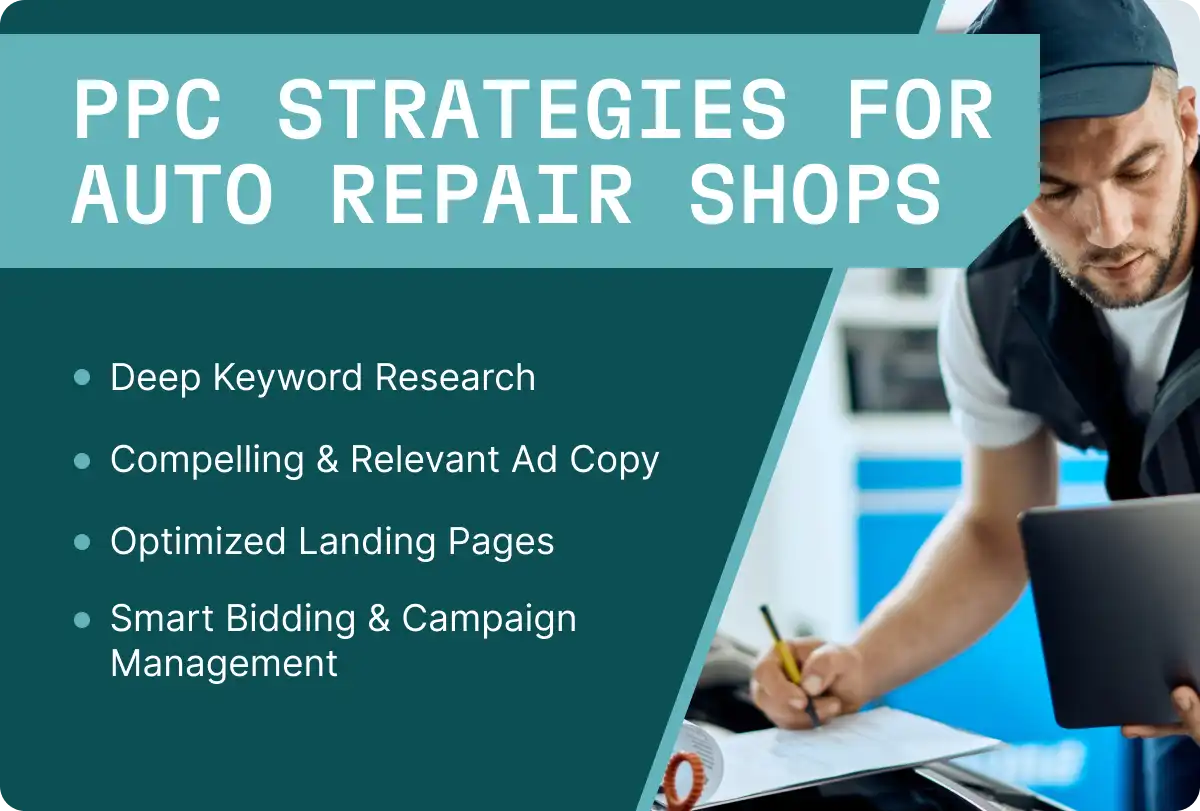
Effective PPC Strategies for Auto Repair Shops
Launching a campaign is easy; launching a profitable one requires a solid strategy. Simply throwing money at Google Ads without a plan is a quick way to burn through your budget. Here are the essential strategies to ensure your PPC ads deliver results.
Keyword Research
This is the foundation of your entire campaign. You need to get inside the heads of your target audience and think of keywords they would search for. Your keyword research should include:
Service-Specific Keywords: "brake pad replacement," "transmission repair," "car AC service."
"Near Me" Keywords: These are huge for local service businesses. Google often appends "near me" automatically for mobile searchers.
Negative Keywords: Just as important is telling Google what not to show your ads for. Add negative keywords like "jobs," "training," "DIY," "parts," and "free" to avoid paying for irrelevant clicks from job seekers or people looking to do the work themselves.
You should note that each keyword has a different cost per click average depending on location and number of competitors. Bid on keywords that are important for your shop and fit your budget.
Compelling Ad Copy
Your ad copy is your 3-second elevator pitch. It needs to grab attention and persuade the user to click.
Highlight Your Strengths: What makes you different? Mention your ASE-certified technicians, warranties on parts and labor, free loaner cars, 5-star reviews, or your years of experience.
Include a Strong Call-to-Action (CTA): Be direct. Use phrases like "Call Now for a Free Estimate," "Book Your Service Online," or "Get a Quick Quote."
Use Ad Extensions: These are extra snippets of information that make your ad bigger and more useful. Use call extensions to add your phone number for easy click-to-call, and location extensions to show your address and link to Google Maps. Sitelink extensions can direct users to specific service pages on your website.
Optimized Landing Pages
A click is wasted if the user gets to your website and is confused or unimpressed. Your landing pages must be designed to convert visitors into customers.
Relevance is Key: If your ad promises "Brake Repair Services," the landing page should be all about your brake repair services, not your homepage.
Mobile-First Design: The majority of auto repair searches happen on mobile phones. Your page must load fast and be easy to navigate on a small screen.
Clear Contact Information: Your phone number and address should be prominently displayed and clickable.
Build Trust: Feature customer reviews, testimonials, photos of your shop, and logos of any certifications (ASE, AAA Approved, etc.).
Bidding and Campaign Management
Google Ads is not a "set it and forget it" strategy. To truly succeed, you need to actively manage and optimize your campaigns.
Structure Your Campaigns: Create separate PPC campaigns for each major service category (e.g., Brakes, Engine, Transmission, General Maintenance). This allows you to tailor your ads and landing pages for maximum relevance, which Google rewards with a better Quality Score and lower CPC.
Track Everything: Implement conversion tracking to monitor not just clicks, but actual leads—phone calls and form submissions. This is the only way to measure true campaign performance.
Continuously Optimize: Regularly review your metrics. Pause keywords that aren't performing, test new ad copy, and adjust bids to focus your ad spend on what drives the best conversion rates.
How Much Should Automotive Shops Invest in Google Ads?
This is the most common question, and the answer is: it depends. The right budget for your shop is influenced by several factors, including your location's competitiveness, the specific services you're advertising, and your overall growth goals. A shop in rural Nebraska will have a much lower cost per click than one in downtown Los Angeles.
Instead of focusing on a magic number, think about your investment in terms of objectives and ROI. A good starting point for a small to medium-sized auto repair shop might be anywhere from $500 to $2,000 per month. This initial investment allows you to gather enough data to see what works.
The most important metric isn't the upfront price; it's the return on investment. If you spend $1,000 on Google Ads in a month and it brings in five new repair jobs that generate $4,000 in revenue, your marketing efforts have delivered a 4x return. From that perspective, the initial cost is more than justified.
For shops new to this space, partnering with a digital marketing agency that specializes in Google AdWords services can be a wise investment. They have the expertise to avoid common pitfalls, maximize your budget, and accelerate your path to profitability.
Final Thoughts
In a competitive market, standing still means falling behind. Pay-per-click advertising is the fuel your marketing strategy needs to accelerate past the competition. It offers an unparalleled ability to connect with customers at their moment of need, providing immediate, targeted, and measurable results.
By conducting thorough keyword research, crafting compelling ads, building high-converting landing pages, and diligently tracking your campaign performance, you can transform your online presence from a sputtering engine into a finely tuned machine that consistently delivers new customers. It’s time to take control of your lead generation and explore what a well-executed auto repair PPC campaign can do for your shop.







.svg)



.svg)

.svg)
.svg)
.svg)
.svg)
.svg)
.svg)